
Encuesta nacional sobre la criminalización del 2021
El Estudio nacional sobre la penalización del VIH aumenta nuestra comprensión de las opiniones y experiencias de las personas que viven con el VIH sobre las leyes que penalizan la transmisión, la exposición y la no revelación del estado serológico respecto al VIH. Los datos de este informe resumen las experiencias de las personas que viven con el VIH en Estados Unidos.
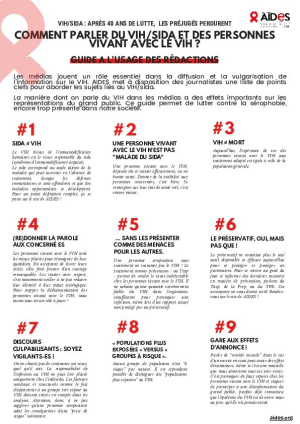
Comment parler du VIH et des personnes vivant avec le VIH – Guide à l’usage des rédactions
Les médias jouent un rôle essentiel dans la diffusion et la vulgarisation de l’information sur le VIH. AIDES met à disposition des journalistes une liste de points clefs pour aborder les sujets liés au VIH/sida. La manière dont on parle du VIH dans les médias a des effets importants sur les représentations du grand public. Ce guide permet de lutter contre la sérophobie, encore trop présente dans notre société.
OptTest Estudio de caso 7: Mitigación de la criminalización de la transmisión del VIH: Inglaterra y Gales
En muchos países de Europa se ha procesado a personas con el VIH por la transmisión, la exposición o incluso por la mera percepción de la exposición al VIH. Las leyes y las respuestas han variado. Este estudio de caso examina los enfoques adoptados por personas de Inglaterra y Gales en respuesta a lo que consideraban un uso inadecuado del derecho penal para procesar a personas con el VIH por "delitos" relacionados con la transmisión.
Este documento fue traducido de su idioma original usando DeepL Pro (una aplicación web basada en inteligencia artificial) a fin de facilitar la lectura del contenido para los usuarios de la HIV Justice Academy. Reconocemos las limitaciones de las traducciones realizadas a través de este tipo de tecnología y no podemos garantizar la precisión de la versión traducida.
- Alternative links
- English (Automated translation)
Le système est défaillant – Audit des lois australiennes sur le dépistage obligatoire
L'audit, mené par Sally Cameron, analyste politique senior du HIV Justice Network, au nom du HJN et de la National Association of People with HIV Australia (NAPWHA), révèle que les lois sur le dépistage obligatoire sont en contradiction avec la politique nationale de dépistage du VIH et fonctionnent en dehors des réponses structurées et très réussies au VIH gérées par les cliniciens et les départements de la santé. L'audit a révélé que dans de nombreux cas, les lois, leur mise en œuvre et leur suivi comportent de nombreuses défaillances structurelles, qui se produisent généralement dans plusieurs États.
Ce document a été traduit de sa langue d'origine à l'aide de DeepL Pro (une technologie de traduction en ligne basée sur l’intelligence artificielle) pour offrir aux utilisateurs de HIV Justice Academy une plus grande sélection de ressources. Nous sommes conscients des limites de la traduction automatique et ne garantissons donc pas l'exactitude de la traduction.
- Alternative links
- English
La inferencia causal, el problema de la demarcación y el uso del análisis filogenético en el proceso penal: ¿Hacia una nueva figura de juez?
A la luz de la estructura lógica de la «abducción jurídca», el artículo aborda las cuestiones concernientes a la selección del conocimiento nomológico explicativo –con especial referencia a la evaluación de su fiabilidad y al problema de la «demarcación»– y al uso de pruebas científicas para comprobar el nexo de causalidad entre acción y resultado. En particular, el autor centra su atención en la Sentencia de la Corte de Casación italiana (2016) sobre el caso del terremoto de L’Aquila (2009) y en el uso del análisis filogenético en los procesos por contagio del VIH y del VHC. En las conclusiones, se defiende la necesidad de que a los jueces se les proporcione una formación interdisciplinaria adecuada para que puedan entender la naturaleza de las cuestiones científicas que se plantean en los procesos penales.
VIH, discriminación y derechos – Guía para personas que viven con el VIH
Esta guía está dirigida a las personas que viven con el VIH, y su contenido se centra en el estigma, la discriminación y los derechos.
En las siguientes páginas se explica en qué consisten estos problemas; cuáles son las actitudes de la población hacia la personas con el VIH; de qué manera puedes afrontar y abordar el estigma
y la discriminación; y cuáles son tus derechos legales en los diferentes ámbitos y qué puedes hacer en caso de vulneración de los mismos.
La información contenida es complementaria a la ofrecida por los servicios de consultoría legal y puede resultarte muy útil en caso de que necesites el asesoramiento de un/a profesional de la abogacía.
Revue du cadre juridique Burkinabe de la riposte au VIH et SIDA
Ce document est une analyse du cadre legal burkinabe se portant sur des questions de criminalisation des populations clefs et comprenant une section sur la criminalisation de la transmission du VIH au Burkina Faso (page 77).