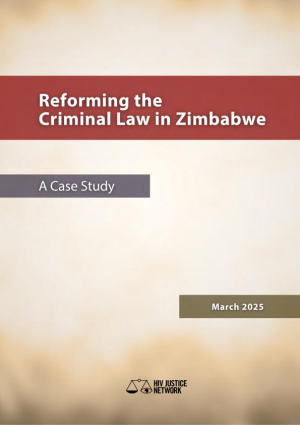
Reforming the criminal law in Zimbabwe: A case study
The report, Reforming the Criminal Law in Zimbabwe: A Case Study, explores how advocates, legal experts, and community leaders worked together to repeal Section 79 of Zimbabwe’s Criminal Code, which criminalised HIV non-disclosure, exposure, or transmission. It outlines key strategies used in the campaign and lessons for other countries seeking to end HIV criminalisation.
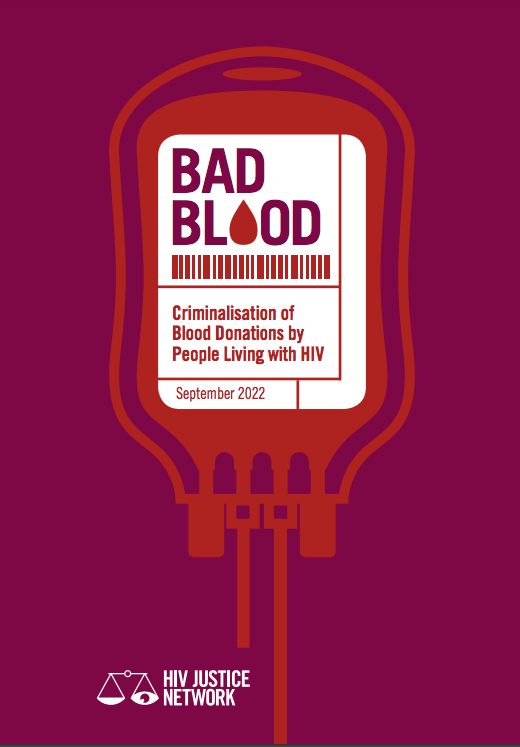
Bad Blood: Criminalisation of Blood Donations by People Living with HIV
Following recent reports of blood donation-related prosecutions in Russia, Singapore, and the United States, the HIV Justice Network undertook desk-based research, collating and categorising all known country and jurisdictional laws that specifically criminalise blood donations by people living with HIV, and known prosecutions under these laws. We analysed these laws and cases using a global policy guidance and human rights law framework, informed by international and state-level scientific data assessing risks of transmission via blood transfusion.
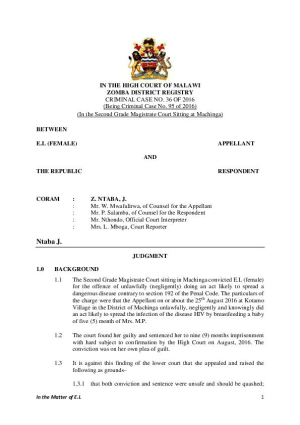
E.L. Judgement, Malawi High Court (2016)
On 19 January 2017, the Zomba High Court in Malawi delivered a landmark ruling on the application of criminal law to cases of HIV transmission and exposure through breastfeeding.
The appellant was a woman living with HIV who was convicted of negligently and recklessly doing an act which is “likely to spread the infection of any disease which is dangerous to life” under section 192 of the Malawi Penal Code for accidentally breastfeeding another person’s child. She was unrepresented at her trial and sentenced to nine months’ imprisonment.
Before the High Court, she appealed her conviction and sentence and challenged the constitutionality of section 192 of the Penal Code for being vague and overbroad. She raised expert evidence to show the “infinitesimally small risk” of HIV transmission by women on antiretroviral treatment through breastfeeding. The State agreed that the appellant’s conviction and sentence should be overturned and set aside.
At the hearing on 2 December 2016, the Court, per Ntaba J, granted an order that the appellant’s identity be concealed to protect her confidentiality and that of the children concerned.
On 19 January 2017, the High Court acquitted the appellant and ordered her immediate release. It held that the proceedings in the trial court were irregular and “blatantly bias” against the appellant, compromising her right to a fair trial. The Court held that the appellant did not have the requisite knowledge or belief that breastfeeding the complainant’s child was likely to spread HIV and cautioned against the misapplication of criminal law in cases of HIV transmission and exposure. The Court recommended the constitutional challenge be filed for separate determination considering the national interest in the issue.
The appellant was represented by Mr Wesley Mwafulirwa of John Tennyson Associates.
- Alternative links
- HJN feature on the impact of this case, SALC resources on this case