Submission to the Review of Part 4 of the Criminal Law (Sexual Offences) Act 2017
HIV Ireland's submission as part of the Review of Part 4 of the Criminal Law (Sexual Offences) Act 2017. The submission urges the Review Committee to fully decriminalise sex work in order to respect, protect and fulfil the right to the highest attainable standard of health of sex workers; to take into account the negative impact that current legislative provisions are having on sexual health and to consider the detrimental effects that current legislative provisions are having on access to justice for sex workers and to ensure that their voices are feature prominently throughout the review.
UNAIDS Terminology Guidelines – 2024
Language shapes beliefs and may influence behaviours. Considered use of appropriate language has the power to strengthen the global response to the AIDS epidemic. That is why the Joint United Nations Programme on HIV/AIDS (UNAIDS) is pleased to make these guidelines to Preferred terminology freely available for use by staff members, colleagues and other partners working in the global response to HIV
HIV and AIDS and Labour Rights: A Handbook for Judges and Legal Professionals
"This Handbook aims to assist judges and legal professionals in handling HIV and AIDS-related matters with a focus on employment and occupation. It provides information on relevant national and international law and its application in domestic courts operating in diverse legal traditions and frameworks." ILO
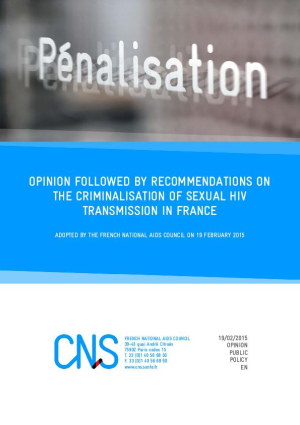
Opinion followed by recommendations on the criminalisation of the sexual transmission of HIV in France
Presents an assessment of the legal, ethical, societal and health issues raised by criminal proceedings brought in France for acts of transmission or exposure to the risk of sexual transmission of HIV.
Determinants of Per-Coital-Act HIV-1 Infectivity Among African HIV-1–Serodiscordant Couples
Reports data from a prospective study of African HIV-1–serodiscordant couples assessing transmissions for linkage within the study partnership, based on HIV-1 sequencing. Modifiable risk factors were (HIV-positive partner) RNA level and condom use, and (HIV-negative partner) presence of STIs and male circumcision.
HIV transmission risk through anal intercourse: systematic review, meta-analysis and implications for HIV preventions
Reports findings from systematic review and meta-analysis of the literature on HIV-1 infectiousness through anal intercourse.
Eminent judges unite to address HIV, human rights and the law
Describes a meeting of some 30 judges from the highest national courts of 16 countries in Asia and the Pacific to discuss the role of the judiciary in responding to HIV. Judges also debated the specific actions that can be taken to create a more supportive legal and social environment for people living with and vulnerable to HIV in the region.

HIV criminal prosecutions and public health: an examination of the empirical research
Concludes that HIV-related criminal laws either fail to influence or increase STI testing avoidance, unprotected anonymous sexual contacts, and avoidance of health care because respondents do not feel safe speaking with health professionals. Suggests HIV-related criminal laws compromise public health and clinicians’ abilities to establish therapeutic relationships and to undertake HIV prevention and treatment work.