
The ABC’s of HIV law reform in Latin America and the Caribbean
We interviewed key players in the Latin American and the Caribbean region to understand what led to law reform in three countries between 2019 and 2023: Argentina (2022), Belize (2023) and Colombia (2019). While the process in each country was, and always is, a product of factors unique to the local context and cannot be replicated exactly, lessons can be drawn from these case studies that are likely to be relevant to other countries.

The Expert Consensus Statement on the Science of HIV in the Context of Criminal Law – Five-year Impact Report: Bringing Science to Justice
In 2018, twenty leading HIV scientists published the ‘Expert Consensus Statement on the Science of HIV in the Context of Criminal Law’ (Expert Consensus Statement) to address the misuse of HIV science in punitive laws and prosecutions against people living with HIV for acts related to sexual activity, biting or spitting. The process involved undertaking detailed analysis of the best available scientific and medical research data on HIV transmission, treatment effectiveness and forensics. Building on an initial scoping report published in 2020, the HIV Justice Network (HJN) undertook further research between April and July 2023 examining the impact of the Expert Consensus Statement in cases and advocacy in the five years since its publication.
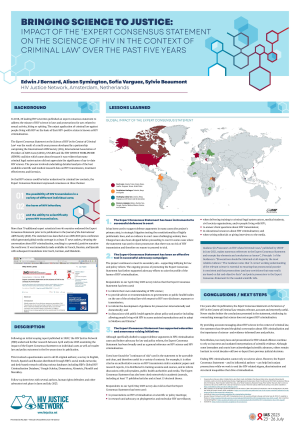
Bringing Science to Justice: Impact of the Expert Consensus Statement on the Science of HIV in the context of criminal law over the past five years (Poster)
Research findings on the five-year impact of the ‘Expert Consensus Statement on the Science of HIV in the Context of Criminal Law’, presented at the International AIDS Conference (IAS 2023). The research examined the impact of the Expert Consensus Statement on individual cases as well as broader law and policy outcomes in the five years since its publication and found that the statement remains relevant, accurate and extremely useful. Newer studies bolster the conclusions presented in the statement, reinforcing its overarching message that science does not support HIV criminalisation.

HIV Criminalization Scan in the countries of Eastern Europe and Central Asia
This report, produced by EWNA, focuses on the criminalisation of HIV transmission, which remains a serious human rights concern in EECA, and includes findings from country informants, including women living with HIV, on laws and policies that criminalise people living with HIV in the EECA region. The report is based on data from 11 countries in the EECA region: Armenia, Belarus, Estonia, Georgia, Kazakhstan, Kyrgyzstan, Moldova, Russia, Tajikistan, Ukraine and Uzbekistan.
Please note that this report was machine translated via Google translate.
- Alternative links
- Russian

Judgment C-248/19 – Lawsuit challenging the constitutionality of Article 370 of Law 599 of 2000 “Whereby the Criminal Code is issued.”
The decision of the Constitutional Court of Colombia to eliminate section 370 of the criminal code that criminalised the transmission of HIV.