
HIV Criminalization in Latin America and the Caribbean: Advances and Challenges
The 2024 report by the Action Network for Justice for People Affected by HIV/AIDS (Action Network) documents legal cases in the region where individuals are penalized for conduct linked to their HIV status, even in the absence of evidence of transmission or intent to cause harm. The report also notes instances involving serious offenses such as sexual violence or pedophilia, which the Action Network unequivocally condemns.

Submission to the International Commission of Jurists: Developing principles to address the detrimental impact on health, equality and human rights of criminalization with a focus on select conduct in the areas of sexuality, reproduction, drug use and HIV
This submission was prepared based on discussions that occurred during a meeting of the HIV JUSTICE WORDWIDE Steering Committee. The meeting focused on HIV criminalisation, noting that this frequently intersects with other issues including those being considered by ICJ.

Special considerations for advising sexual assault complainants living with HIV
This paper is devoted to issues faced by a group of individuals with a unique experience: sexual assault complainants living with HIV who could potentially be transformed from complainants to accused persons. In particular, this paper will discuss some of the factors that arise in these situations and aims to provide some guidance on the advice lawyers can provide to sexual assault complainants living with HIV to assist them in navigating these potentially complex situations.
I = I : réalité scientifique vs criminalisation du VIH
Résumé d'une étude publiée en juin 2022 sur le site Taylor & Francis Online (d'après l'article original en anglais publié sur Aidsmap). L'étude qualitative a été menée en aout 2020 avec de longs entretiens via Zoom avec vingt hommes gays et séropositifs sous traitement avec une charge virale indétectable. Les participants étaient originaires de toutes les régions des États-Unis et âgés de 23 à 62 ans.
HIV Criminalisation Defence Case Compendium
This HIV Criminalisation Defence Case Compendium aims to support lawyers acting for those who are alleged to have put others at risk of HIV. Based on research conducted in late 2017, it includes criminal cases from all over the world where strong defence arguments have resulted in an acquittal or reduced penalty for persons living with HIV who have been accused of HIV exposure, non-disclosure or transmission.
The Compendium is not intended to be comprehensive. It has been developed as a resource for a training of lawyers from Africa – “Lawyers for HIV and TB justice: Strategic litigation, legal defence and advocacy training” – held in Johannesburg, South Africa from 20-23 February 2018.

Criminal laws on sex work and HIV transmission: Mapping the laws, considering the consequences
Presents a public health law mapping of U.S. states that mandate HIV testing and criminalize HIV positive sex workers. Shows HIV transmission and exposure laws interact with sex work laws to compound criminal penalties for people charged with prostitution related crimes. Argues that decriminalization of sex work and HIV transmission and exposure is integral to effectively address the HIV epidemic.
U.S. HIV Laws and Prosecutorial Tools, CHLP (updated 2022)
This chart from the Center for HIV Law and Policy, developed in 2013 and last updated in 2022, details each U.S. state’s HIV-specific laws in relation to various areas including spitting, biting, sharing needles, sex, and sex work, as well as HIV-specific sentence enhancement.
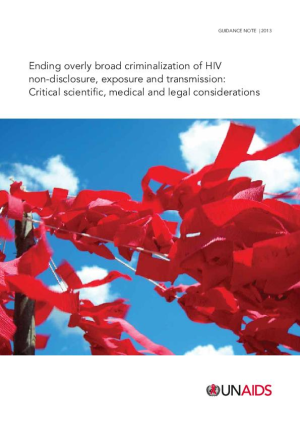
Ending overly broad criminalisation of HIV non-disclosure, exposure and transmission: Critical scientific, medical and legal considerations
Restates UNAIDS’ position on criminalisation and makes specific recommendations to help governments, policy-makers, law enforcement officials, and civil society limit the overly broad application of criminal law to HIV.
- Alternative links
- Spanish / Español
La criminalización de la transmisión del VIH: Política de salud pública deficiente
Un artículo influyente del Honorable Edwin Cameron, exjuez del Tribunal Constitucional de Sudáfrica, sobre el papel que desempeña el estigma en la criminalización del VIH.
Este documento fue traducido de su idioma original usando DeepL Pro (una aplicación web basada en inteligencia artificial) a fin de facilitar la lectura del contenido para los usuarios de la HIV Justice Academy. Reconocemos las limitaciones de las traducciones realizadas a través de este tipo de tecnología y no podemos garantizar la precisión de la versión traducida.
- Alternative links
- Français
10 razones para oponerse a la penalización de la exposición al y la transmisión del VIH
Contiene diez razones por las que criminalizar la exposición o transmisión del VIH constituye una política pública injusta e ineficaz. En el texto se argumenta que es poco probable que la criminalización sirva para prevenir nuevas infecciones o reducir la vulnerabilidad de las mujeres frente al VIH. Por el contrario, la criminalización puede perjudicar a las mujeres y tiene un impacto negativo sobre la salud pública y los derechos humanos.