Report of the Special Select Committee on the Criminal Responsibility of HIV Infected Individuals (Resolution No.129/2010)
Report from GUYANA'S Special Select Committee of Parliament on the Criminal Responsibility of HIV Infected Individuals that chose not to make the transmission of HIV a criminal act, concluding that the transmission or exposure will be a major set-back in the country's existing national HIV response, and would undermine the excellent work that is currently being done locally to address HIV.

The Criminalisation of HIV in Angola – Discussion document
This brief has been prepared for Civil Society Organisations (CSOs) working on HIV and human rights in Angola, to contribute to discussions around criminalisation of HIV in the country. It sets out concerns regarding the criminalisation of HIV transmission, exposure and non-disclosure in general, based on compelling scientific developments and the position of international human rights and public health experts. It further examines the relevant laws and their application in Angola, provides alternatives to criminalisation and concludes with specific recommendations regarding the reform of such laws in the country.
This brief is also available in Portuguese.
- Alternative links
- Portuguese
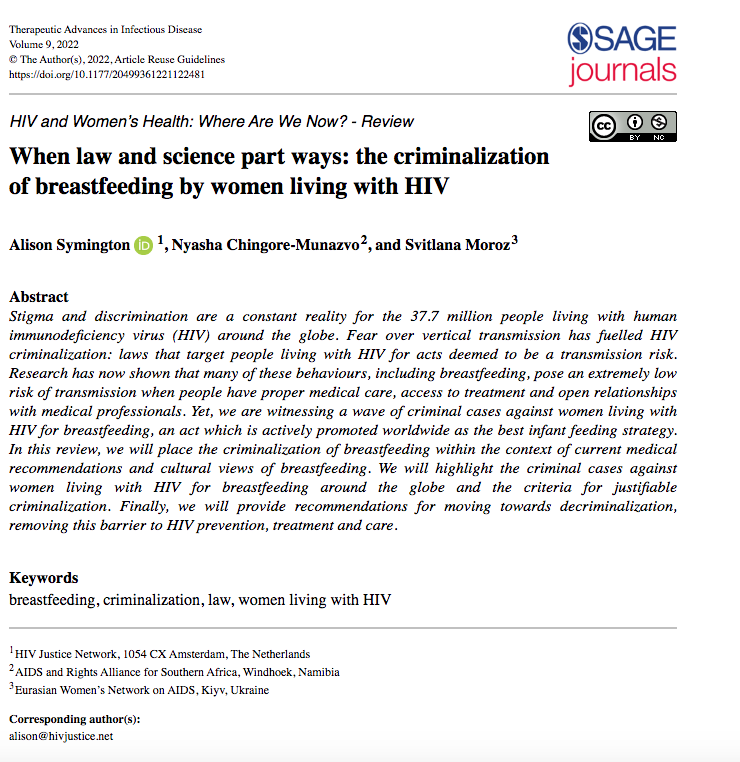
When law and science part ways: the criminalization of breastfeeding by women living with HIV
In this study, the authors place the criminalisation of women with HIV for breastfeeding within the context of current medical recommendations and cultural views of breastfeeding. They review the criminal cases against women living with HIV for breastfeeding around the globe, examine the injustice of these prosecutions, and provide recommendations for decriminalisation.
Promoción y justicia social: medición de impacto
En esta publicación, HIV Legal Network hace una presentación sucinta de algunas ideas sobre cómo monitorear y medir el impacto como defensores, y aprender de ello - particularmente en relación con el trabajo de defensa legal.
Este documento fue traducido de su idioma original usando DeepL Pro (una aplicación web basada en inteligencia artificial) a fin de facilitar la lectura del contenido para los usuarios de la HIV Justice Academy. Reconocemos las limitaciones de las traducciones realizadas a través de este tipo de tecnología y no podemos garantizar la precisión de la versión traducida.
El texto original está disponible en https://www.hivlegalnetwork.ca/site/our-story/measuring-impact/?lang=en

Consensus Statement on HIV “Treatment as Prevention” in Criminal Law Reform
The Consensus Statement is a collaborative document that grew out of the recognition of a need for guidance on how the science of HIV treatment and prevention tools relates to the reform of HIV criminal laws.
Beyond criminalization: reconsidering HIV criminalization in an era of reform
This paper reviews recent studies examining the application of HIV-specific criminal laws in North America (particularly the United States and Canada). In the wake of the development of new biomedical prevention strategies, many states in the United States (US) have recently begun to reform or repeal their HIV-specific laws. These findings can help inform efforts to ‘modernize’ HIV laws (or, to revise in ways that reflect recent scientific advances in HIV treatment and prevention).
Vertical HIV transmission should be excluded from criminal prosecution (2009)
Joanne Csete and colleagues argue that criminal laws on HIV transmission and exposure should be reviewed and revised to ensure that vertical transmission is explicitly excluded as an object of criminal prosecution. Scaling up PMTCT services and ensuring that they are affordable, accessible, welcoming and of good quality is the most effective strategy for reducing vertical transmission of HIV and should be the primary strategy in all countries.
Iniciativa con proyecto de decreto por el que se reforma el articulo 76 y se deroga el articulo 159 del Código Penal del Distrito Federal
La presente intervención presentó ante el pleno del Congreso de la Ciudad de México una iniciativa para derogar un artículo del Código Penal capitalino que criminaliza la portación del VIH, así como un punto de acuerdo para solicitar a las autoridades policiacas que la distribución de preservativos entre las y los trabajadores sexuales y sus clientes no sea motivo de que se finque el delito de trata de personas.
HIV Criminalization in Florida – Penal Implications for People Living with HIV/AIDS
Provides an overall understanding of the enforcement of HIV criminalization laws in Florida and assesses any preliminary findings indicating disparities between subpopulations. Preliminary analyses found that there is evidence of disparities in enforcement of HIV criminalization laws related to geography, race/ethnicity, sex at birth, or sex worker (or suspected sex worker) status and underlying related offenses.

Pénalisation de la transmission du VIH: L’analyse phylogénétique au centre du cas de Draguignan
Considère l'utilité de l'analyse phylogénétique dans les affaires de criminalisation du VIH, constatant que l'analyse phylogénétique ne peut pas prouver que la transmission du VIH a eu lieu directement entre deux individus. Explique que l'analyse phylogénétique peut exonérer des individus en démontrant que le défendeur portait une souche virale sans rapport avec celle du plaignant.
Traduction libre d’après : BERNARD, Edwin J. AZAD, Yusef. VANDAMME, Anne-Mieke. WEAIT, Matthew. GERETTI, Anna Maria. (2007). The use of phylogenetic analysis as evidence in criminal investigation of HIV transmission.
Advancing HIV Justice 2: Renforcer la dynamique du plaidoyer mondial contre la criminalisation du vih
Fournit un rapport d'étape sur les réalisations et les défis du plaidoyer mondial contre la criminalisation du VIH d'avril 2013 au 30 septembre 2015.
Ce document a été traduit de sa langue d'origine à l'aide de DeepL Pro (une technologie de traduction en ligne basée sur l’intelligence artificielle) pour offrir aux utilisateurs de HIV Justice Academy une plus grande sélection de ressources. Nous sommes conscients des limites de la traduction automatique et ne garantissons donc pas l'exactitude de la traduction.
- Alternative links
- English