

HIV Language Guide
This guide includes language suggestions for communicating about HIV and related topics. It aims to help scientists, administrators, and researchers use fair, accurate, and respectful language and aid funded research networks, sites, centres, investigators, and stakeholders as they draft protocols and develop communications and outreach materials. The Language Guide describes current thinking and best practices and procedures.
HIV and the LAW in Australia: National Audit
This is an audit of Australian laws and policies undermining the goals and key areas of action of the National HIV Strategy. This audit deals mainly with three topics, which have a substantial and adverse impact on persons with HIV as well as other marginalised communities and the broader Australian population. These laws: criminalise HIV transmission, exposure and the failure to disclose HIV status to a sexual partner; define consent in a way that exposes people with HIV to criminalisation; and enable Mandatory Disease Testing (MDT) that adversely impacts people with HIV. For each of these topics, this audit: sets out the relevant laws of each state and territory in Australia; notes the key issues in the area; and outlines suggestions on law reform options.

Advancing HIV Justice: Achievements and Challenges in Global Advocacy Against HIV Criminalisation – African Update (ICASA 2013)
Although North America is the continent with the most known prosecutions, 26 African countries have overly broad and/or vague HIV-specific criminal laws and another 3 are considering enacting similar laws. This analysis reviewed global efforts in five broad areas: building the global evidence base; generating persuasive social science; challenging new laws; advocating for law reform; and addressing legal processes and enforcement.
PRACTICAL GUIDE FOR PARALEGALS: Supporting People Living with HIV Affected by HIV Criminalization in the EECA Region
The purpose of this guide is to raise the legal awareness of activists from the community of people living with HIV who provide paralegal assistance to people affected by the criminalisation of HIV. This guide is also recommended for use by activists from key populations - people who use drugs, sex workers, and representatives of the LGBT community. This manual reflects the experience of the HIV-positive community members, as well as their partners and associates from across Eastern Europe and Central Asia (EECA), in providing direct assistance to HIV-positive people affected by discriminatory HIV-specific laws and the decriminalisation of HIV.
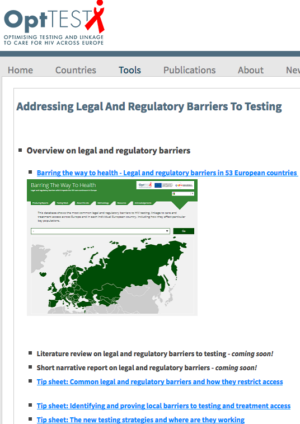
OptTEST: Addressing Legal And Regulatory Barriers To Testing
This EU-funded project on improving access to testing and treatment continuum includes some detailed and informative HIV criminalisation case studies (Netherlands, Denmark and England & Wales) as well as nine advocacy tip sheets such as 'Simple principles for effective campaigning', 'Getting the evidence for policy changes' and 'What can we do when politicians ignore the evidence?'

Advocacy in action: A toolkit to support NGOs and CBOs
This toolkit, produced jointly by the Alliance and the International Council of AIDS Service Organizations (ICASO), shows NGOs and CBOs how they can use advocacy to influence people in power, to create an environment that protects the rights, health and welfare of everyone, whether HIV positive or negative. It sets out to build practical skills, provide a training resource and continue learning.