

Special considerations for advising sexual assault complainants living with HIV
This paper is devoted to issues faced by a group of individuals with a unique experience: sexual assault complainants living with HIV who could potentially be transformed from complainants to accused persons. In particular, this paper will discuss some of the factors that arise in these situations and aims to provide some guidance on the advice lawyers can provide to sexual assault complainants living with HIV to assist them in navigating these potentially complex situations.
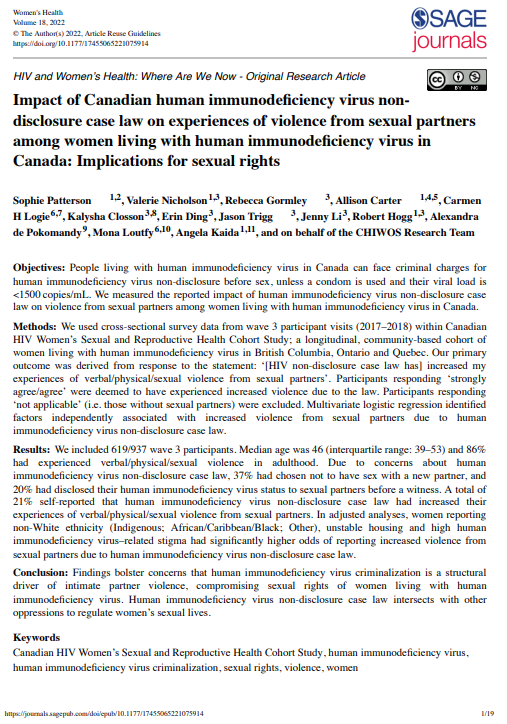
Impact of Canadian human immunodeficiency virus non-disclosure case law on experiences of violence from sexual partners among women living with human immunodeficiency virus in Canada: Implications for sexual rights
Study measured the reported impact of HIV non-disclosure case law on violence from sexual partners among women living with human immunodeficiency virus in Canada. Findings bolster concerns that human immunodeficiency virus criminalisation is a structural driver of intimate partner violence, compromising sexual rights of women living with HIV. HIV non-disclosure case law intersects with other oppressions to regulate women’s sexual lives.
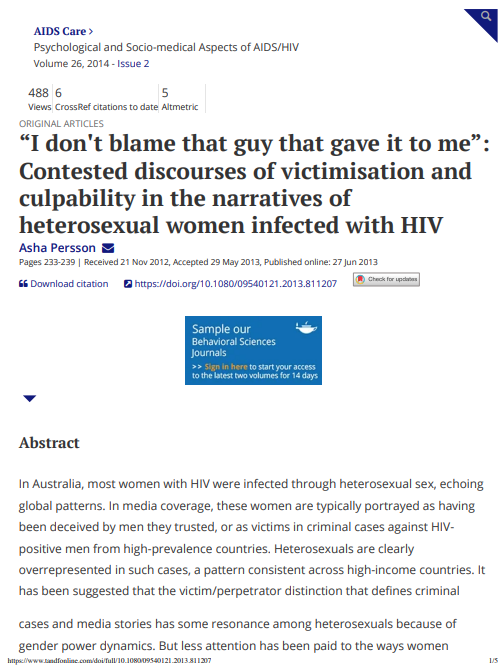
“I don’t blame that guy that gave it to me”: Contested discourses of victimisation and culpability in the narratives of heterosexual women infected with HIV
Considers how heterosexual women living with HIV make sense of their HIV acquisition, challenging the victim–culprit binary. None of the women interviewed presented themselves as ‘victims’ in any straightforward sense or placed the blame squarely on the men who likely infected them, including men who had not disclosed. Instead, the women’s narratives revealed themes of “mutual vulnerability” and far more ambivalent allocations of responsibility. The tendency to position women who become infected with HIV as ‘victims’ obscures the complex realities of gender and sexual practice.
The impact of criminalization of HIV non-disclosure on the healthcare engagement of women living with HIV in Canada: A comprehensive review of the evidence
Concludes that HIV-related criminal laws either fail to influence or increase STI testing avoidance, unprotected anonymous sexual contacts, and avoidance of health care because respondents do not feel safe speaking with health professionals. Suggests HIV-related criminal laws compromise public health and clinicians’ abilities to establish therapeutic relationships and to undertake HIV prevention and treatment work.