Bad Blood: Criminalisation des dons de sang par les personnes vivant avec le VIH
Suite à des rapports récents sur des poursuites liées au don de sang en Russie, à Singapour et aux Etats-Unis, le Réseau Justice VIH a entrepris une recherche documentaire, en rassemblant et en classant toutes les lois connues des pays et des juridictions qui criminalisent spécifiquement le don de sang par des personnes vivant avec le VIH, ainsi que les poursuites connues en vertu de ces lois. Nous avons analysé ces lois et ces cas en utilisant un cadre mondial d'orientation politique et de droit des droits de l'homme, éclairé par des données scientifiques internationales et étatiques évaluant les risques de transmission par transfusion sanguine.
Ce document a été traduit de sa langue d'origine à l'aide de DeepL Pro, une technologie de traduction en ligne basée sur l’intelligence artificielle
Enforcement of HIV Criminalization in Tennessee
Williams Institute analysis of data from the state of Tennessee about individuals who were convicted of an HIV crime and placed on the state’s sex offender registry (SOR). In addition to the registry data, the report also analyses detailed data from 77 case files of those on Tennessee’s SOR who resided and were prosecuted in Shelby County, home of Memphis.
Jugement Semba, Haute Cour du Zimbabwe (2015)
Le raisonnement du juge Charles Hungwe qui a accueilli l'appel au nom d'une femme de 26 ans, a été accusée du crime de transmission délibérée du virus de l'immunodéficience humaine ("VIH") tel que défini dans l'article 79 (1) (a) du Code pénal pour avoir brièvement allaité par erreur le bébé d'une autre femme.
Le jugement a conclu que les poursuites étaient "mal conçues car le législateur n'avait pas l'intention de criminaliser l'allaitement par des femmes infectées mais ignorantes. En tout état de cause, il n'y avait aucune preuve que l'appelante avait pleinement conscience que sa conduite entraînerait la transmission du VIH. En conséquence, elle avait droit à un acquittement lors de son procès".
- Alternative links
- English
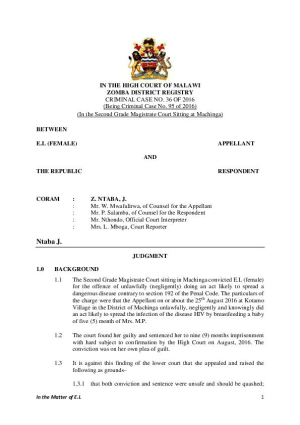
E.L. Judgement, Malawi High Court (2016)
On 19 January 2017, the Zomba High Court in Malawi delivered a landmark ruling on the application of criminal law to cases of HIV transmission and exposure through breastfeeding.
The appellant was a woman living with HIV who was convicted of negligently and recklessly doing an act which is “likely to spread the infection of any disease which is dangerous to life” under section 192 of the Malawi Penal Code for accidentally breastfeeding another person’s child. She was unrepresented at her trial and sentenced to nine months’ imprisonment.
Before the High Court, she appealed her conviction and sentence and challenged the constitutionality of section 192 of the Penal Code for being vague and overbroad. She raised expert evidence to show the “infinitesimally small risk” of HIV transmission by women on antiretroviral treatment through breastfeeding. The State agreed that the appellant’s conviction and sentence should be overturned and set aside.
At the hearing on 2 December 2016, the Court, per Ntaba J, granted an order that the appellant’s identity be concealed to protect her confidentiality and that of the children concerned.
On 19 January 2017, the High Court acquitted the appellant and ordered her immediate release. It held that the proceedings in the trial court were irregular and “blatantly bias” against the appellant, compromising her right to a fair trial. The Court held that the appellant did not have the requisite knowledge or belief that breastfeeding the complainant’s child was likely to spread HIV and cautioned against the misapplication of criminal law in cases of HIV transmission and exposure. The Court recommended the constitutional challenge be filed for separate determination considering the national interest in the issue.
The appellant was represented by Mr Wesley Mwafulirwa of John Tennyson Associates.
- Alternative links
- HJN feature on the impact of this case, SALC resources on this case


