
Document on criminalisation case on the risk of HIV transmission through exclusive breastfeeding
The purpose of this paper is to report on a recent case of HIV criminalisation that occurred in August 2022, in the province of San Luis, Argentina, where a woman with HIV was criminalised for accessing her right to choose how to exclusively breastfeed her baby.
Please note this is a DEEPL translation of the Spanish report.
Enforcement of HIV Criminalisation in Ohio – Analysis of court cases from 2014 to 2020
Equality Ohio Education Fund (EOEF) and the Ohio Health Modernization Movement (OHMM) collaborated for over three years to for the first time gather data across all 88 counties in Ohio about the use of HIV Criminalisation laws and the consequences of HIV criminalization across Ohio. This effort, which is the first of its kind in Ohio, catalogs the criminal cases charged in Ohio from 2014-2020 under any of Ohio’s six statutes that criminalize or create penalty enhancements for people living with HIV.
The Threat Lives On: How to Exclude Expectant Mothers from Prosecution for Mere Exposure of HIV to their Fetuses and Infants (2015)
This article articulates how the threat of prosecution of mothers living with HIV who expose or transfer the virus to their foetuses or newborn will discourage and scare women away from seeking proper medical treatment instead of encouraging HIV treatment and prevention. It also explores how HIV-specific criminal transmission laws in the United States could hamper and stifle the progress in prevention and treatment of vertical transmission. It concludes by proposing a model for change in addressing these HIV-specific criminal transmission statutes.
- Alternative links
- Traduction française automatisée

Using Science for Justice: The Implications of the Expert Consensus Statement on Zimbabwe’s HIV Criminalisation Law
The article finds that, if applied by lawyers, prosecutors and courts, the Expert Consensus Statement may alleviate some unjust prosecutions and convictions in guiding courts to assess evidence on HIV transmission, to draw appropriate inferences on mental elements of the offence, to recognise defences on the basis of transmission risk-reducing conduct, and to more appropriately inform the courts’ assessment of the harm of HIV infection in sentencing. The implications of the science reflected in the Expert Consensus Statement may also weigh in favour of a finding by the courts that the offence is unconstitutional if a new constitutional case is made against the offence.

How reliable is an undetectable viral load
Considers the reliability of viral load as a condition preventing HIV transmission. Found reliability is high with compliance taking medication the most important factor predicting reliability.
Advancing HIV Justice 2: Building momentum in global advocacy against HIV criminalisation
Provides a progress report of achievements and challenges in global advocacy against HIV criminalisation from April 2013 to 30 September 2015.
- Alternative links
- Français (Traduction automatisée),
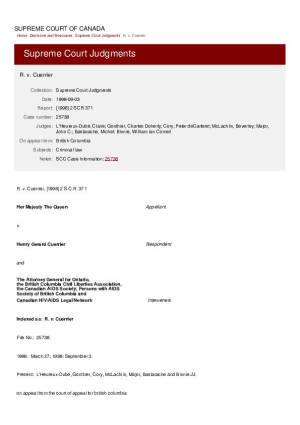
Her Majesty the Queen v. Henry Gerald Cuerrier
Ruling that failure to disclose HIV status constitutes fraud. Consequently, a partner’s consent to unprotected sexual activity is not valid. This ruling allows people with HIV in Canada who do not disclose their HIV-status before sex to be prosecuted under sexual assault laws.