Reading List

General Comments No.1 on Article 14 (1) (d) and (e) of the Protocol to the African Charter on Human and Peoples’ Rights on the Rights of Women in Africa

The Protocol to the African Charter on Human and Peoples’ Rights on the Rights of Women in Africa (the Maputo Protocol) is the first international legally binding human rights instrument to recognize the intersection between women’s human rights and HIV. In Article 14 (1) (d) and (e), the Maputo Protocol lays down women’s right to self-protection and to be protected from HIV infection, as well as their right to be informed of their HIV status and the HIV status of their partners in accordance with international standards and practices in force. As such, the Maputo Protocol is therefore, in practice, an important tool towards the alleviation of the disproportionate effect of the HIV pandemic on the lives of women in Africa. Even though considered as a landmark, the provisions of the Maputo Protocol on HIV are not very explicit on the measures to be taken by States Parties to ensure the full implementation of women’s rights to sexual and reproductive health. In order to meet this objective, the African Commission on Human and Peoples’ Rights (the Commission) adopted these General Comments on Article 14 (1) (d) and (e) at its 52nd Ordinary Session held from 9 to 22 October 2012 in Yamoussoukro, Côte d’Ivoire.

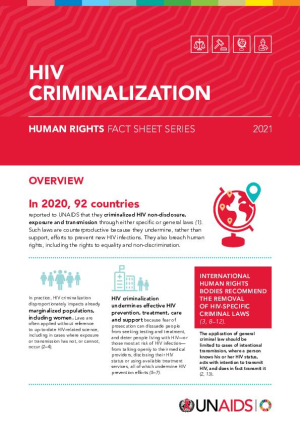
HIV Criminalization – Human Rights Fact sheet Series

Series of fact sheets on human rights highlighting the critical need to scale up action on rights. Short, easy to digest and accessible document outlining the latest epidemiology, the evidence of the impact of human rights interventions, the latest targets, and international guidelines, recommendations and human rights obligations.

Other factsheets in the same series released in June 2021 include: HIV and people who use drugsHIV and gay men and who have sex with other menHIV and transgender and other gender-diverse peopleHIV and sex workHIV and people in prisons and other closed settings and HIV and stigma and discrimination.