The Criminalisation of HIV in Angola – Discussion document
This brief has been prepared for Civil Society Organisations (CSOs) working on HIV and human rights in Angola, to contribute to discussions around criminalisation of HIV in the country. It sets out concerns regarding the criminalisation of HIV transmission, exposure and non-disclosure in general, based on compelling scientific developments and the position of international human rights and public health experts. It further examines the relevant laws and their application in Angola, provides alternatives to criminalisation and concludes with specific recommendations regarding the reform of such laws in the country.
This brief is also available in Portuguese.
- Alternative links
- Portuguese
When law and science part ways: the criminalization of breastfeeding by women living with HIV
In this study, the authors place the criminalisation of women with HIV for breastfeeding within the context of current medical recommendations and cultural views of breastfeeding. They review the criminal cases against women living with HIV for breastfeeding around the globe, examine the injustice of these prosecutions, and provide recommendations for decriminalisation.
Role of Media in Ending Criminalisation of HIV – Media Toolkit 2021-2023
The purpose of this media toolkit is to help health journalists and advocates understand HIV criminalisation in Zimbabwe and adequately engage with the various facets of arguments and viewpoints on the subject matter. Journalists and advocates are key stakeholders in promoting public health goals and the advancement of rights and freedoms of those infected and affected by HIV.
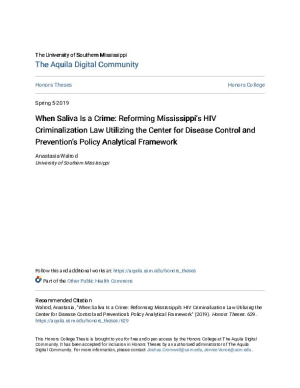
When Saliva Is a Crime: Reforming Mississippi’s HIV Criminalization Law Utilizing the Center for Disease Control and Criminalization Law Utilizing the Center for Disease Control and Prevention’s Policy Analytical Framework
In this study, Mississippi’s existing policy was identified using the Center for Disease Control and Prevention’s Policy Analytical Framework, and three possible policy options were analyzed and scored based on public health impact, feasibility, and economic and budgetary impact. Results of this analysis strongly indicate that Mississippi Code ANN. § 97-27-14 should be amended to be scientifically accurate and include a criminalization clause based on the National HIV/AIDS Strategy for the United States goals and the United States Department of Justice Civil Rights Division best practices.
Male circumcision for the prevention of heterosexually acquired HIV infection: a meta-analysis of randomized trials involving 11 050 men
Systemic review of medical literature found male circumcision is an effective strategy for reducing new male HIV infections, however, its impact at population level requires consistently safe sexual practices to maintain the protective benefit.