
The Criminalisation of HIV in Angola – Discussion document
This brief has been prepared for Civil Society Organisations (CSOs) working on HIV and human rights in Angola, to contribute to discussions around criminalisation of HIV in the country. It sets out concerns regarding the criminalisation of HIV transmission, exposure and non-disclosure in general, based on compelling scientific developments and the position of international human rights and public health experts. It further examines the relevant laws and their application in Angola, provides alternatives to criminalisation and concludes with specific recommendations regarding the reform of such laws in the country.
This brief is also available in Portuguese.
- Alternative links
- Portuguese
Beyond criminalization: reconsidering HIV criminalization in an era of reform
This paper reviews recent studies examining the application of HIV-specific criminal laws in North America (particularly the United States and Canada). In the wake of the development of new biomedical prevention strategies, many states in the United States (US) have recently begun to reform or repeal their HIV-specific laws. These findings can help inform efforts to ‘modernize’ HIV laws (or, to revise in ways that reflect recent scientific advances in HIV treatment and prevention).
A Litigation Guide on Crimes of Sex Working and Homosexuality
This an English Summary of the book “A Litigation Guide on Crimes of Sex Working and Homosexuality (Prostitution and Debauchery) “. The book aims to provide a litigation guide and a legal overview of principles and procedures to legal advocates and whoever wishes to know more about “prostitution” or “debauchery” crimes under Egyptian law.
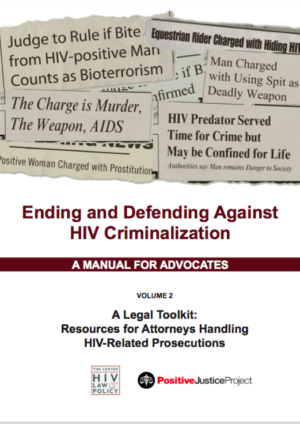
A Legal Toolkit: Resources for Attorneys Handling HIV-Related Prosecutions
This toolkit produced by the Center for HIV Law and Policy (CHLP) for the Positive Justice Project in 2013, provides multiple resources (including case law, legal analysis and scientific data) for lawyers representing people facing HIV criminalisation, and other advocates.
HIV Forensics II – Estimation de la probabilité d’une infection récente par le VIH – implications pour les poursuites pénales
Examine la validité et la signification des tests scientifiques (Algorithme de test d'infection récente) pour estimer la probabilité d'une infection récente chez les personnes diagnostiquées séropositives dans le contexte des poursuites pour transmission du VIH.
- Alternative links
- English
Médecine légale du VIH : pièges et normes acceptables dans l’utilisation de l’analyse phylogénétique comme preuve dans les enquêtes criminelles sur la transmission du VIH
Examine l'utilité de l'analyse phylogénétique dans les procès criminels relatifs au VIH, et conclut que l'analyse phylogénétique ne peut pas prouver que la transmission du VIH s'est produite directement entre deux individus. Explique que l'analyse phylogénétique peut disculper des individus en démontrant que le défendeur était porteur d'une souche virale sans rapport avec celle du plaignant.
Ce document a été traduit de sa langue d'origine à l'aide de DeepL Pro (une technologie de traduction en ligne basée sur l’intelligence artificielle) pour offrir aux utilisateurs de HIV Justice Academy une plus grande sélection de ressources. Nous sommes conscients des limites de la traduction automatique et ne garantissons donc pas l'exactitude de la traduction.
- Alternative links
- English
Report on assessment of the legal environment for HIV and AIDS in Lesotho
Designed to help governments and civil society review laws and policies based on human rights, and increase capacity to achieve enabling legal environments. Includes recommendations on criminalisation at p.38.
The East African Legislative Assembly passes the EAC HIV & AIDS Prevention and Management Bill
April 2012 passing of the HIV & AIDS Prevention bill by the East African Legislative Assembly (Tanzania, Kenya, Uganda, Rwanda and Burundi). The bill offers a constructive alternative to the N’Djamena Model Laws promoting HIV criminalisation. The Bill followed strong actions by civil society including numerous stakeholder meetings of civil society and politicians.


