Reading List

Enforcement of HIV Criminalization in Michigan

Using data obtained from the Criminal History Record database maintained by the Michigan State Police Criminal Justice Information Center, this study examines the enforcement of HIV nondisclosure laws from 1991 to 2024.

Infant Feeding for Persons Living With and at Risk for HIV in the United States: Clinical Report

The AAP recommends that for people with HIV in the United States, replacement feeding (with formula or certified, banked donor human milk) is the only option that is 100% certain to prevent postnatal transmission of HIV. However, pediatric health care professionals should be prepared to provide infant feeding counseling and a family-centered, culturally sensitive, harm reduction approach for people with HIV on ART with sustained viral suppression who desire to breastfeed.

Criminalizing Contagion: Legal and Ethical Challenges of Disease Transmission and The Criminal Law Summary of Key Findings and Outputs (Nov 2014)

This seminar series1 addressed a series of questions and brought together experts from a range of disciplines to answer them. This document summarises the arguments of each of the papers presented over the course of this seminar series, gives details of outputs connected to it, and also provides information on how and by whom we anticipate findings being used.

A Litigation Guide on Crimes of Sex Working and Homosexuality

This an English Summary of the book “A Litigation Guide on Crimes of Sex Working and Homosexuality (Prostitution and Debauchery) “. The book aims to provide a litigation guide and a legal overview of principles and procedures to legal advocates and whoever wishes to know more about “prostitution” or “debauchery” crimes under Egyptian law.

Recommandations de l’ONUSIDA concernant la modification de certains articles problématiques de la loi de N’Djamena sur le VIH (2004)

Dans ce document, ONUSIDA propose une formulation différente de certaines dispositions de la loi de N’Djamena (loi portant sur la protection des droits des personnes vivant avec le VIH). Une de ces propositions concerne la criminalisation de la transmission du VIH (articles 1 et 36).

Fast Track and Human Rights – Advancing human rights in efforts to accelerate the response to HIV

Spells out for the first time (on p23) that there must be “Non-criminalization of mother-to-child transmission” when a country applies for validation for the elimination of mother-to-child transmission of HIV. This  marks the first time in public health history that human rights guarantees are considered a prerequisite to validating disease elimination.

A Legal Toolkit: Resources for Attorneys Handling HIV-Related Prosecutions

This toolkit produced by the Center for HIV Law and Policy (CHLP) for the Positive Justice Project in 2013, provides multiple resources (including case law, legal analysis and scientific data) for lawyers representing people facing HIV criminalisation, and other advocates.

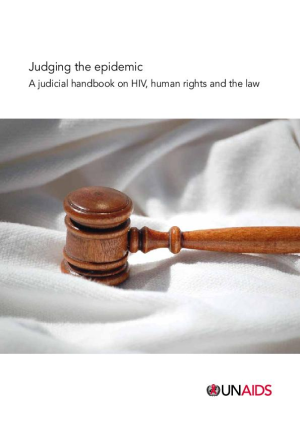
Judging the epidemic: A judicial handbook on HIV, human rights and the law

Prepared as a resource to help judges, magistrates, arbitrators and other judicial officers throughout the world adjudicate cases involving HIV-related issues. Based on international legal and human rights standards, the handbook contains examples of decided cases from different jurisdictions, good-practice advice and judicial rulings on HIV-related issues.

The East African Legislative Assembly passes the EAC HIV & AIDS Prevention and Management Bill

April 2012 passing of the HIV & AIDS Prevention bill by the East African Legislative Assembly (Tanzania, Kenya, Uganda, Rwanda and Burundi). The bill offers a constructive alternative to the N’Djamena Model Laws promoting HIV criminalisation. The Bill followed strong actions by civil society including numerous stakeholder meetings of civil society and politicians.

Reform of Offences Against the Person

Recommends replacing the outdated Offences Against the Person Act 1861 with a modified version of a 1998 draft Bill. Includes a detailed discussion of submissions by 35 concerned stakeholders (at chapter six: ‘transmission of disease’) .

Des lois efficaces pour en finir avec le VIH et le sida : agir au Parlement

Informe les parlementaires sur les types de lois susceptibles d’avoir des effets positifs ou négatifs sur la lutte contre le sida. Elle donne des exemples de législations qui, dans diverses parties du monde, ont permis de limiter efficacement la propagation du VIH, et tire les enseignements de l’expérience des parlementaires concernés. Le contenu de cette brochure va au dela de la criminalisation du VIH.

Position Paper: The Need for New Charge Assessment Guidelines: HIV Non-Disclosure in British Columbia

Outlines different ways to address HIV non-disclosure: charge assessment guidelines, a public health approach, and prosecutorial guidelines. Provides recommendations.