Reading List

Timeline of State Reforms and Repeals of HIV Criminal Laws, CHLP (2025)

This resource for community advocates from CHLP outlines a timeline of major repeals and reforms to HIV criminal laws in US states that have implemented significant changes since 1994. Originally released in February 2020, it was fully updated in May 2025.

Breastfeeding and HIV: An example of what stigma, discrimination and lack of information can cause.

This video reflects the story of a woman from Argentina who was prosecuted for wanting to breastfeed her baby and in the success of the defense of her rights with the accompaniment of ICW Argentina so that she could comply with the reproductive right of breastfeeding.

Tracing the “Infectious Criminal”: A Genealogy of HIV Criminalization and Infectious Injustice in Finland

This article examines the junction of state healthcare and punishment through HIV criminalization. By problematizing the application of criminal law to HIV in Finland, the study locates a genealogy of the “infectious criminal” – a figure at the cusp of these two forms of state power. The article traces how this figure, evoked in official debates from the early 20th century onwards, justified punitive measures to control marginalized people, from poor merchants to prisoners-of-war, sex workers, vagrants, and later, migrants. Drawing on parliamentary archives, the article asks how punishment and existing social injustices are narrated, maintained, and connected. Revealing a continuum of punishment and healthcare, HIV criminalization – especially within a nation deemed exceptionally non-punitive and welfare-oriented – is a crucial point from which to examine the connections of social injustice and criminal justice.

In the era of U=U, disclosure still feels like a ‘grey messy area’ for gay men living with HIV in the US

Summary of a study published in June 2022 on the Taylor & Francis Online website. The qualitative study was conducted in August 2020 with extensive interviews via Zoom with twenty HIV-positive gay men on treatment with undetectable viral loads. Participants were from all regions of the United States and ranged in age from 23 to 62.

Система сломана – Аудит законов Австралии об обязательном тестировании

Аудит, проведенный Салли Кэмерон, старшим аналитиком по вопросам политики Сети правосудия по ВИЧ, от имени HJN и Национальной ассоциации людей с ВИЧ Австралии (NAPWHA), показал, что законы об обязательном тестировании противоречат национальной политике тестирования на ВИЧ и действуют вне структурированных и весьма успешных мер по борьбе с ВИЧ, управляемых клиницистами и департаментами здравоохранения. Аудит показал, что во многих случаях законы, их реализация и мониторинг включают многочисленные структурные сбои, обычно происходящие в нескольких штатах.

Этот документ был переведен с языка оригинала с помощью DeepL Pro (технологии перевода на основе искусственного интеллекта), чтобы обеспечить доступ пользователей Академии правосудия по ВИЧ к большему объему контента. Мы отдаем себе отчет в ограниченных возможностях машинного перевода и не гарантируем точности переведенной версии документа 

Alternative links
English

Advancing HIV Justice 3 – Promover la justicia del VIH: El crecimiento del movimiento global en contra de la criminalización del VIH – Resumen

Promover la justicia del VIH: El crecimiento del movimiento global en contra de la criminalización del VIH es un reporte sobre el estatus de los logros y desafíos con respecto a la incidencia global en contra de la criminalización del VIH llevada a cabo entre el 1 de octubre de 2015 y el 31 de diciembre de 2018. Este es un resumen sobre los puntos más importantes del documento.

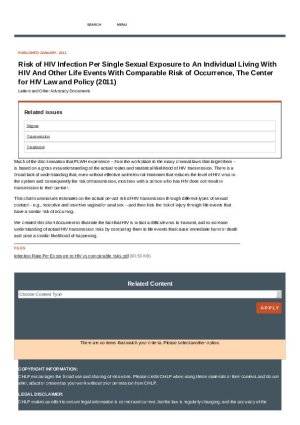
Risk of HIV Infection Per Single Sexual Exposure to an Individual Living with HIV, and Other Life Events Comparable Risk of Occurrence

Compares risk of HIV transmission from a single sexual encounter with odds of illness or death from other life events.

Pity Mpofu Samukelisiwe Mlilo v The State, Consitutional Court of Zimbabwe

On appeal, the Consitutional Court of Zimbabwe decided the only defence to prosecution is disclosure of known or potential HIV infection and suggested people with HIV can be discriminated against by the law if the reason is to protect public health.

Zaburoni v The Queen

Clarifies that recklessness regarding HIV transmission risk is not the same as intention to transmit HIV. This ruling means that if people are convicted of having sex without disclosing their HIV status, they will be convicted of lesser charges with lower penalty.