Reading List

Decriminalizing Disease: A Health Justice Approach to Infectious Diseases and Criminal Law

This Article seeks to re-frame the discussion around the legal framework for infectious diseases in a way that moves beyond a punishment mindset and toward a health justice mindset. The focus in this Article is on health justice rather than traditional understandings of public health, defined as the science and practice of improving the health of people and their communities.

It argues that health justice, when applied to infectious diseases, requires decriminalisation. Health justice aligns with the abolitionist project to dismantle carceral practices and implement non-carceral approaches

From N’Djamena to SADC & EAC Model Laws and Beyond: Revolutionising approaches to Criminalisation of HIV non-disclosure & exposure

ARASA in collaboration with the HIV Justice Worldwide (HJWW) Consortium, convened a two-day meeting involving policy and law makers, members of the judiciary, lawyers, parliamentarians and representatives from civil society organisations from the East African, SADC regions and global North to revisit alternative approaches towards criminalisation and to accelerate a sustained momentum, strengthen collective action. 

8th Symposium on HIV, Law and Human Rights

The report of the HIV Legal Network's 8th HIV, Law and Human Rights Symposium held in 2019 summarizes the discussions of the Forum where survivors of HIV criminalization shared their experiences and where experts in the field presented updates on the current state of HIV criminalization in Canada, the latest scientific developments surrounding HIV transmission and the future of advocacy efforts in the country.

Start the Press: How African communities in the UK can work with the media to confront HIV stigma

Argues that by speaking out, people with HIV and leaders among African communities can raise awareness of the discrimination they experience. Suggests HIV advocates can get to know the media and work with journalists to tell their stories on their own terms, spotlighting inaccurate and misleading coverage and targeting stigma. Includes language guide.

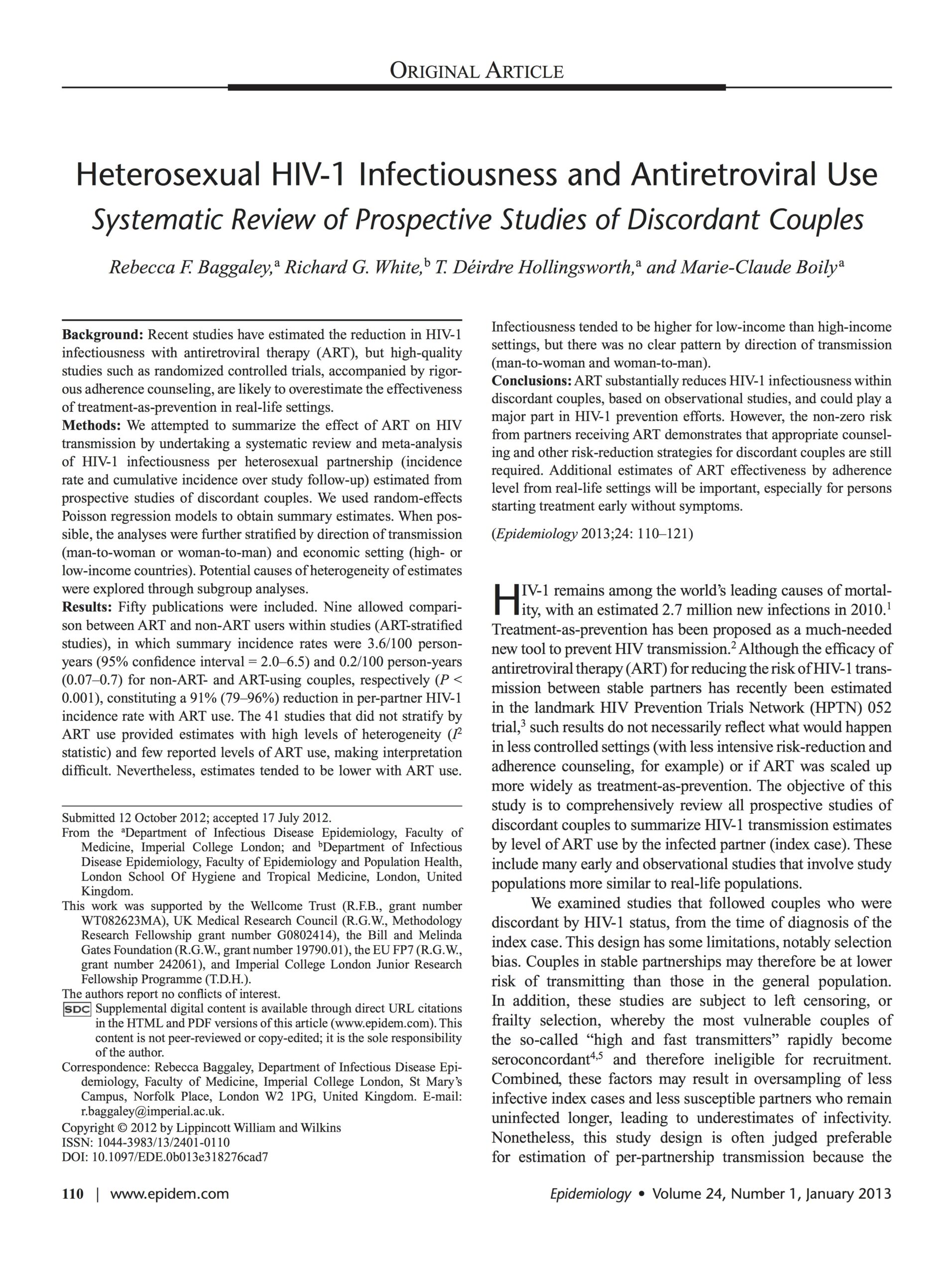
Heterosexual HIV-1 infectiousness and antiretroviral use: systematic review of prospective studies of discordant couples

Systemic review and meta-analysis of 50 studies considered HIV transmission risk between heterosexual partners. Found ART substantially reduces HIV infection risk within serodiscordant couples.
HIV forensics: pitfalls and acceptable standards in the use of phylogenetic analysis as evidence in criminal investigations of HIV transmission

Considers the usefulness of phylogenetic analysis in HIV criminal trials, finding that phylogenetic analysis cannot prove that HIV transmission occurred directly between two individuals. Explains that phylogenetic analysis can exonerate individuals by demonstrating that the defendant carried a virus strain unrelated to that of the complainant.

Alternative links
Français, Español, Русский, HIV Medicine Wiley Online Library

HIV Non-Disclosure and the Criminal Law: Establishing Policy Options for Ontario

Provides an overview and analysis of criminal cases of HIV exposure and transmission to 2010, and proposes policy options for addressing the problems posed by the criminalization of HIV non-disclosure.

When Sex is a Crime and Spit is a Dangerous Weapon: A Snapshot of HIV Criminalization in the United States

Map by the Center for HIV Law and Policy showing details of U.S. states with HIV specific laws, HIV-related prosecutions, sentence enhancement provisions, and sex offender registration.

Legal and clinical implications of HIV non-disclosure: A practical guide for HIV nurses in Canada

Provides guidance on the complexities many nurses face working with people living with HIV including how to document advice on disclosure and responding to a search warrant.