
Community Insights in Phylogenetic HIV Research: The CIPHR Project Protocol
Protocol for engaging community activists living in Nairobi, Kenya in a knowledge exchange process: Drawing upon a community-based participatory approach, the CIPHR project will (1) explore the possibilities and limitations of HIV molecular epidemiology for key population programmes, (2) pilot a community-based HIV molecular study, and (3) co-develop policy guidelines on conducting ethically safe HIV molecular epidemiology. Critical dialogue with activist communities will offer insight into the potential uses and abuses of using such information to sharpen HIV prevention programmes. The outcome of this process holds importance to the development of policy frameworks that will guide the next generation of the global response.
The Criminalization of HIV Non-Disclosure in Canada – Report of the Standing Committee on Justice and Human Rights
Ground-breaking report recommending that the Government of Canada works with each of the Canadian provinces and territories to end the use of sexual assault law to prosecute allegations of HIV non-disclosure.
A systematic review of risk of HIV transmission through biting or spitting: implications for policy
A systematic literature search was conducted using Medline, Embase and Northern Lights databases and conference websites. Results showed that there was no risk of transmitting HIV through spitting, and the risk through biting was negligible. Post‐exposure prophylaxis was not indicated after a bite in all but exceptional circumstances. Policies to protect emergency workers should be developed with this evidence in mind.
- Alternative links
- Español (Traducción automática), Français (Traduction automatisée)
HIV Criminalization in California: What We Know
Highlights significant findings about Californian criminal law including that more than 800 people have come in contact with California’s criminal system based on their HIV status, with 93% of convictions requiring no proof of conduct likely to transmit HIV. Also finds HIV criminal statutes are disparately enforced based on race/ethnicity, sexuality and gender.
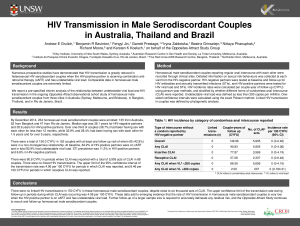
HIV Transmission in Male Serodiscordant Couples in Australia, Thailand and Brazil
Reports an interim analysis of the relationship between undetectable viral load and HIV transmission in the Opposites Attract observational cohort study of homosexual male serodiscordant couples in Australia. Finds no linked HIV transmissions in 150 ‘couple years of follow up’ among homosexual male serodiscordant couples, despite close to six thousand acts of condomless anal sex.
Advancing HIV Justice 2: Impulso a la defensa global contra la criminalización del VIH
Ofrece un informe de los logros y desafíos en la defensa global contra la criminalización del VIH desde abril de 2013 hasta el 30 de septiembre de 2015.
Este documento fue traducido de su idioma original usando DeepL Pro (una aplicación web basada en inteligencia artificial) a fin de facilitar la lectura del contenido para los usuarios de la HIV Justice Academy. Reconocemos las limitaciones de las traducciones realizadas a través de este tipo de tecnología y no podemos garantizar la precisión de la versión traducida.
- Alternative links
- English
New Zealand Police v Justin William Dalley
Clarifies that use of a condom satisfies the requirement to take ‘reasonable care’ to prevent HIV transmission during vaginal sex, and that ‘failsafe’ precautions are not required by law. Also finds that oral sex without a condom (and without ejaculation) satisfies the standard of ‘reasonable care and precautions’. This ruling means that disclosure of HIV status before vaginal sex is not required as long as a condom is used. Disclosure before oral sex is not required.


