Reading List

Breastfeeding and HIV: An example of what stigma, discrimination and lack of information can cause.

This video reflects the story of a woman from Argentina who was prosecuted for wanting to breastfeed her baby and in the success of the defense of her rights with the accompaniment of ICW Argentina so that she could comply with the reproductive right of breastfeeding.
WHO Guideline: Updates on HIV and Infant Feeding (2016)

The overall purpose of this guideline is to improve the HIV-free survival of HIV-exposed infants by providing guidance on appropriate infant feeding practices and use of ARV drugs for mothers living with HIV in countries with high HIV prevalence and settings in which diarrhoea, pneumonia and undernutrition are common causes of infant and child mortality.

The guideline addresses four aspects of infant feeding in the context of HIV:

  • the duration of breastfeeding by mothers living with HIV;
  • interventions to support infant feeding practices by mothers living with HIV;
  • what to advise when mothers living with HIV do not exclusively breastfeed; and
  • what to advise when mothers living with HIV do not plan to breastfeed for 12 months.

The guideline informs national policy-makers on what may be relevant for national policies and programmes, it provides guidance to health-care providers, researchers and clinicians involved in managing pregnant women and mothers living with HIV at various levels of health care.

New Tech Brief: Roadmap for Key Populations Advocates Navigating the Global Fund

This technical brief seeks to provide an overall snapshot of how the Global Fund mechanism works, to help key populations navigate the pathway to securing funding for their work. It offers toolkits, policy briefs, trainings and other materials that explain different steps of that process in more detail. It also includes case study examples of successful key population programs supported by the Global Fund, in hopes that they inspire creativity, innovation and persistence in driving this work forward.

Heterosexual HIV-1 infectiousness and antiretroviral use: systematic review of prospective studies of discordant couples

Systemic review and meta-analysis of 50 studies considered HIV transmission risk between heterosexual partners. Found ART substantially reduces HIV infection risk within serodiscordant couples.

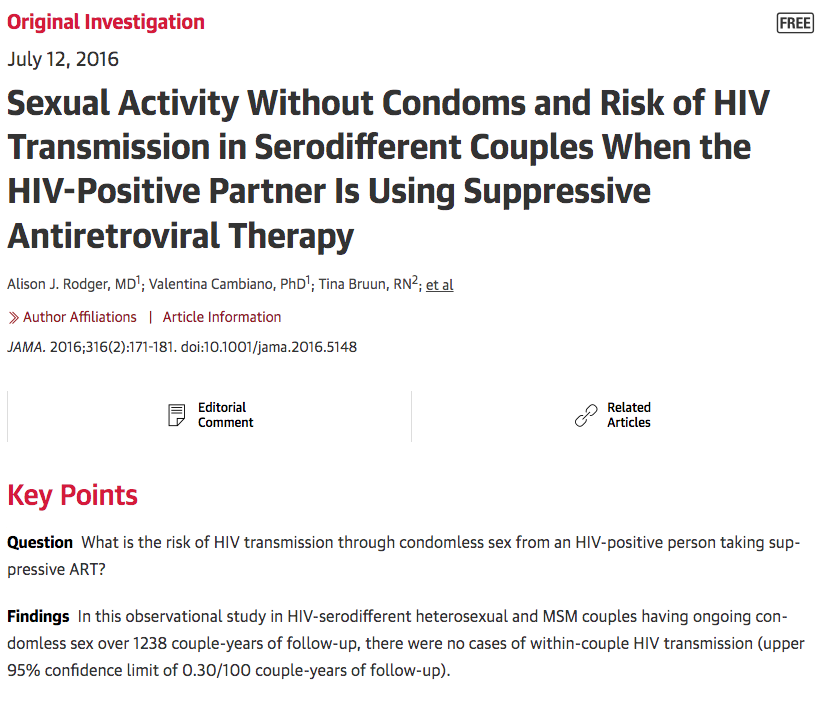
Sexual activity without condoms and risk of HIV transmission in serodifferent couples when the HIV-positive partner is using suppressive antiretroviral therapy

Reports findings of European prospective, observational (PARTNER) study to evaluate the rate of within-couple HIV transmission (heterosexual and men who have sex with men) during periods of sex without condoms when the HIV-positive partner had HIV-1 RNA load less than 200 copies/mL. Found no transmission after 1.3 years.
HIV forensics: pitfalls and acceptable standards in the use of phylogenetic analysis as evidence in criminal investigations of HIV transmission

Considers the usefulness of phylogenetic analysis in HIV criminal trials, finding that phylogenetic analysis cannot prove that HIV transmission occurred directly between two individuals. Explains that phylogenetic analysis can exonerate individuals by demonstrating that the defendant carried a virus strain unrelated to that of the complainant.

Alternative links
Français, Español, Русский, HIV Medicine Wiley Online Library

Best Practices Guide to Reform HIV-Specific Criminal Laws to Align with Scientifically-Supported Factors

Provides technical assistance to states wanting to re-examine HIV-specific criminal laws to ensure that existing policies “do not place unique or additional burdens on individuals living with HIV/AIDS” and that policies “reflect contemporary understanding of HIV transmission routes and associated benefits of treatment.”