Note destinée aux avocats de la défense pénale
Cette note propose des éléments susceptibles d'aider les avocats et les militants. En ce qui concerne les affaires d'allaitement, les lignes argumentaires suivantes peuvent contribuer à une stratégie de défense solide.
Ce document a été traduit automatiquement via DEEPL.com
- Alternative links
- English
La policía, la aplicación de las leyes y el VIH
Este número especial de la revista JIAS contiene ejemplos de cómo la policía y la sociedad civil pueden generar confianza mutua y trabajar en alianza para asegurar la implementación de programas de atención al VIH que sean seguros, respetuosos e inclusivos.
Este documento fue traducido de su idioma original usando DeepL Pro (una aplicación web basada en inteligencia artificial) a fin de facilitar la lectura del contenido para los usuarios de la HIV Justice Academy. Reconocemos las limitaciones de las traducciones realizadas a través de este tipo de tecnología y no podemos garantizar la precisión de la versión traducida.
Orientations pour les Procureurs sur les affaires pénales liées au VIH
Ce document d’orientation présente 10 principes clés qui devraient aider les procureurs à gérer une poursuite – ou une poursuite potentielle – impliquant une allégation de non-divulgation, d’exposition ou de transmission du VIH. Chaque principe est accompagné d’un commentaire plus détaillé examinant l’application spécifique du principe par les procureurs dans le cadre de leur traitement d’une poursuite potentielle ou en cours. Chaque principe et le commentaire qui l’accompagne sont fondés sur l’examen des meilleures preuves scientifiques disponibles, des normes internationales applicables en matière de droits humains, ainsi que des normes professionnelles largement reconnues qui régissent la fonction des procureurs au sein du système de justice pénale.
HIV, the Law and Human Rights in the African Human Rights System: Key Challenges and Opportunities for Rights-Based Responses
Report on the Study of the African Commission on Human and Peoples’ Rights. The report presents the current state of the HIV epidemic in Africa through a human rights and gender lens by showing the populations and locations most affected by HIV and those underserved by the response to the epidemic. It also describes the global, regional and national norms and standards relating to HIV and health, as well as their interpretation and application by African regional mechanisms, United Nations (UN) bodies and national courts and institutions. It further provides a detailed analysis of the key human rights challenges affecting the response to HIV on the continent.
- Alternative links
- Français
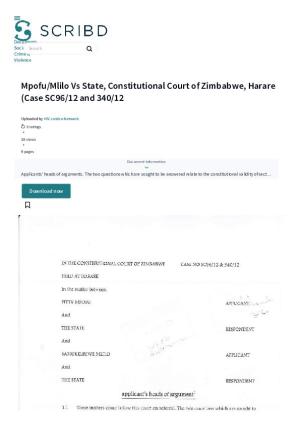
Mpofu/Mlilo vs State, Constitutional Court of Zimbabwe
Challenges Section 79 of the Zimbabwe Criminal Law (Codification and Reform) Act 23 of 2004, with the court deciding the provision was overly broad and unconstitutionally vague.
R. v. Mabior
Ruling on "significant risk of bodily harm" which ostensibly found that people with HIV in Canada do not need to disclose their HIV-status before sex only if (i) the accused’s viral load at the time of sexual relations was low, and (ii) condom protection was used.


