
It’s time to end HIV criminalization
While some individual public health officials have sup- ported efforts to reform HIV criminalization, the contribution of the organized public health profession, as a whole, has been marginal. Public health authorities have been indifferent to such efforts, have been afraid to voice their support, or have actively stood in the way of needed changes.This editorial argues that it is not too late for the public health community to make a difference. There is much work and ongoing advocacy needed for the tide to fully turn on HIV criminalization in this country. A strong public health voice urging the federal government to deliver on its promise to enact principled, evidence-based Criminal Code reforms that end unjust HIV criminalization would make an important contribution.
Decriminalising HIV: Strategies and best practice for legislators
This report from the Global Equality Caucus collates expert insight and best practice examples on HIV criminal law reform. In a series of case studies from around the world, where some of the Global Equality Caucus’s members have led reform efforts, the report identifies several key lessons, takeaways and overarching themes for legislators to consider.
HIV criminalisation laws around the world
HIV criminalisation is a global phenomenon, with problematic legislation in every region of the world. Countries criminalise people with HIV for transmission, exposure and/or non-disclosure of HIV status. This page provides a brief overview with global examples and a link to more detailed and up-to-date information by country.
Implementing and scaling up programmes to remove human rights related barriers to HIV services
This publication builds on existing global technical guidance in human rights responses, and further advances efforts to support implementers to design and deliver high quality human rights programmes that are well integrated, sustainable, and at scale. The guidance is practical and organised around the Investment Approach to HIV. It helps implementers to understand the programmatic components of evidence-informed and quality interventions to remove barriers to services.
No hay transmisión del VIH durante la lactancia por parte de madres con supresión viral en la zona rural de Tanzania (2018)
Breve informe de la práctica clínica en Tanzania en la que no se encontró ninguna transmisión del VIH por parte de las madres que continuaron recibiendo atención médica y mantuvieron la carga viral suprimida durante la lactancia. Se concluye que "la lactancia supone un riesgo muy bajo cuando las madres se adhieren a la terapia antirretroviral".
Disponible únicamente en inglés
Является ли U=U для кормящих матерей и младенцев? Грудное вскармливание матерями, получающими эффективное лечение ВИЧ-инфекции в условиях с высоким уровнем дохода (2018)
Можно ли применить кампанию Неопределяемый=Непередаваемый (U=U), разработанную для передачи ВИЧ половым путем, к передаче ВИЧ при грудном вскармливании? Группа мировых экспертов предлагает дорожную карту совместных исследований для получения недостающих доказательств, необходимых для того, чтобы матери, желающие кормить грудью, могли сделать полностью осознанный выбор.
Этот документ был переведен с языка оригинала с помощью DeepL Pro (технологии перевода на основе искусственного интеллекта), чтобы обеспечить доступ пользователей Академии правосудия по ВИЧ к большему объему контента. Мы отдаем себе отчет в ограниченных возможностях машинного перевода и не гарантируем точности переведенной версии документа
Роль СМИ в прекращении криминализации ВИЧ – Инструментарий для СМИ 2021-2023 гг.
Цель данного инструментария для СМИ - помочь журналистам и правозащитникам в сфере здравоохранения понять криминализацию ВИЧ в Зимбабве и адекватно взаимодействовать с различными аспектами аргументов и точек зрения по данному вопросу. Журналисты и адвокаты являются ключевыми участниками процесса продвижения целей общественного здравоохранения и продвижения прав и свобод тех, кто инфицирован и затронут ВИЧ.
Этот документ был переведен с языка оригинала с помощью DeepL Pro (технологии перевода на основе искусственного интеллекта), чтобы обеспечить доступ пользователей Академии правосудия по ВИЧ к большему объему контента. Мы отдаем себе отчет в ограниченных возможностях машинного перевода и не гарантируем точности переведенной версии документа
Систематический обзор риска передачи ВИЧ через укус или плевок: последствия для политики
Систематический поиск литературы проводился с использованием баз данных Medline, Embase и Northern Lights, а также сайтов конференций. Результаты показали, что риск передачи ВИЧ через слюну отсутствует, а риск через укус ничтожно мал. Постконтактная профилактика не показана после укуса во всех случаях, кроме исключительных. Политику защиты работников экстренных служб следует разрабатывать с учетом этих данных.
Этот документ был переведен с языка оригинала с помощью DeepL Pro (технологии перевода на основе искусственного интеллекта), чтобы обеспечить доступ пользователей Академии правосудия по ВИЧ к большему объему контента. Мы отдаем себе отчет в ограниченных возможностях машинного перевода и не гарантируем точности переведенной версии документа
- Alternative links
- English
Factum of the Interveners at the Supreme Court of Canada: R v. Mabior and R v. D.C.
Questions whether the offence of aggravated sexual assault can and should be established for HIV non-disclosure in circumstances where, in the Interveners’ submission, there is no “significant risk” of transmission because of factors that dramatically reduce that risk, such as the use of condoms or an undetectable or low viral load
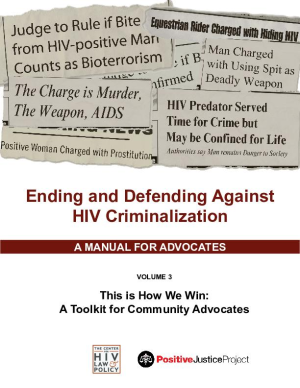
Ending and Defending Against HIV Criminalization: A manual for advocates. Vol 3: This is how we win. A Toolkit for community Advocates
Contains numerous criminalisation documents (also listed separately on this site), including Ten things anyone can do to help end HIV criminalization, How a Bill becomes a law, State-level legislative advocacy cheat sheet, How to talk about HIV criminalization with elected officials, media and others.
Interview with Cynthia Fromstein
Reports interview with Cynthia Fromstein, a Toronto-based criminal lawyer with experience as a defense lawyer in cases regarding HIV non-disclosure. Discusses her experience with laws around HIV disclosure.
La criminalización de la transmisión del VIH: Política de salud pública deficiente
Un artículo influyente del Honorable Edwin Cameron, exjuez del Tribunal Constitucional de Sudáfrica, sobre el papel que desempeña el estigma en la criminalización del VIH.
Este documento fue traducido de su idioma original usando DeepL Pro (una aplicación web basada en inteligencia artificial) a fin de facilitar la lectura del contenido para los usuarios de la HIV Justice Academy. Reconocemos las limitaciones de las traducciones realizadas a través de este tipo de tecnología y no podemos garantizar la precisión de la versión traducida.
- Alternative links
- Français


