Views from the front lines: Breastfeeding and HIV transmission
CATIE talked to three people with expertise in this area and asked them to share their perspectives and experience related to the supports that parents with HIV need in order to make decisions around infant feeding and the challenges they experience related to breastfeeding.
Когда пути закона и науки расходятся: криминализация грудного вскармливания женщинами, живущими с ВИЧ
В данной публикации мы рассмотрим уголовное преследование за грудное вскармливание в контексте актуальных медицинских рекомендаций и культурных установок в отношении грудного вскармливания. Мы расскажем об уголовных делах, возбужденных против женщин, живущих с ВИЧ, за грудное вскармливание в разных странах мира, и о критериях обоснованного уголовного преследования. И, наконец, нами будут предложены рекомендации по достижению прогресса на пути декриминализации и устранения барьеров в доступе к профилактике, лечению и уходу в связи с ВИЧ.
Comments to Uganda’s Parliamentary Committee on HIV/AIDS and Related Matters about the HIV/AIDS Prevention and Control Bill
Argues that a draft HIV bill (2009) including a provision criminalising HIV transmission, contravenes the right to equal protection and non-discrimination under Uganda's constitution and Uganda's obligations under international human rights law. Furthermore, these provisions will prove counterproductive to reducing the burden of the HIV epidemic in the country.
Chapter 13, A controversial issue: HIV transmission/exposure offences, Taking Action Against HIV and AIDS: A Handbook for parliamentarians
Serves as a call to action for parliamentary leadership and a reference guide for legislators and legislative staff. Contains information and guidance on issues specific to the AIDS response. (This resource contains content that is broader than HIV criminalisation.)
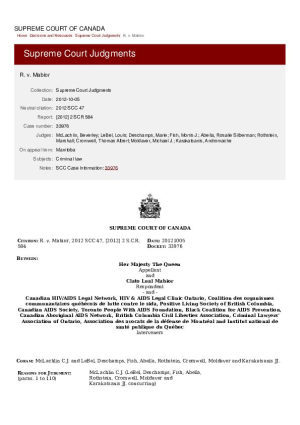
R. v. Mabior
Ruling on "significant risk of bodily harm" which ostensibly found that people with HIV in Canada do not need to disclose their HIV-status before sex only if (i) the accused’s viral load at the time of sexual relations was low, and (ii) condom protection was used.