
Decriminalizing HIV in Indiana: A Policy Analysis
This article examines Indiana’s laws, which are discriminatory and do not reflect the current science of HIV transmission. The Centers for Disease Control and Prevention Policy Analytical Framework was employed, and historical context and public health implications were analyzed, revealing that the most favorable solution to mitigate inequity and support prevention is to repeal HIV-related laws in Indiana. Nurse practitioners must be aware of this discriminatory legislation and contribute to advocacy efforts for policy change by leveraging clinical expertise to influence legislative discussions.
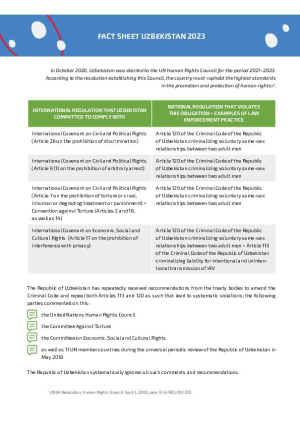
Factsheet Uzbekistan 2022
The Republic of Uzbekistan has repeatedly received recommendations from the treaty bodies to amend the Criminal Code and repeal both Articles 113 and 120 as such that lead to systematic violations. The Republic of Uzbekistan systematically ignores all such comments and recommendations, despite having committed to comply with international regulations.
This factsheet summarises violations from international regulations and recommendations from the treaty bodies.

The risk of sexual transmission of HIV in individuals with low-level HIV viraemia: a systematic review
The risk of sexual transmission of HIV from individuals with low-level HIV viraemia receiving antiretroviral therapy (ART) has important public health implications, especially in resource-limited settings that use alternatives to plasma-based viral load testing. This Article summarises the evidence related to sexual transmission of HIV at varying HIV viral load levels to inform messaging for people living with HIV, their partners, their health-care providers, and the wider public.

New Zealand Police v Justin William Dalley
Clarifies that use of a condom satisfies the requirement to take ‘reasonable care’ to prevent HIV transmission during vaginal sex, and that ‘failsafe’ precautions are not required by law. Also finds that oral sex without a condom (and without ejaculation) satisfies the standard of ‘reasonable care and precautions’. This ruling means that disclosure of HIV status before vaginal sex is not required as long as a condom is used. Disclosure before oral sex is not required.