
Infant Feeding for Persons Living With and at Risk for HIV in the United States: Clinical Report
The AAP recommends that for people with HIV in the United States, replacement feeding (with formula or certified, banked donor human milk) is the only option that is 100% certain to prevent postnatal transmission of HIV. However, pediatric health care professionals should be prepared to provide infant feeding counseling and a family-centered, culturally sensitive, harm reduction approach for people with HIV on ART with sustained viral suppression who desire to breastfeed.
A Call to End HIV Criminalisation in Zimbabwe – Policy Brief
The Brief explains the concept of “HIV criminalisation” and the HIV-related criminal law in Zimbabwe. It describes why it is necessary for the law to be reformed, including why the law violates human rights and is outdated in the light of compelling scientific developments.
HIV Criminalization Legal and Policy Assessment Tool
This assessment tool is designed to help individuals and organizations, including state and local health departments, to assess the extent to which a jurisdiction’s laws and regulations impede HIV surveillance, facilitate privacy breaches, or criminalize HIV infection and related risk behaviors.

Views from the front lines: Breastfeeding and HIV transmission
CATIE talked to three people with expertise in this area and asked them to share their perspectives and experience related to the supports that parents with HIV need in order to make decisions around infant feeding and the challenges they experience related to breastfeeding.
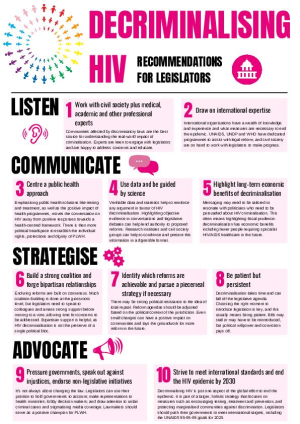
Decriminalising HIV – Recommendations for Legislators
Based on the research, studies and consultations that informed the report Decriminalising HIV: Strategies and best practice for legislators, The Global Equalities Caucus has identified several common themes across different regions and contexts and proposes 10 recommendations for legislators working to decriminalise HIV.
Bibliography on Criminalization of HIV Non-Disclosure, Exposure, And Transmission
Overview of resources outlining criminal laws and analyses of case laws; empirical research in the US and Canada; legal and public health analyses; guidance, fact sheets and talking points; policy and consensus statements, and other relevant references on criminalization in a North American context.
Scientific research on the risk of the sexual transmission of HIV infection and on HIV as a chronic manageable infection
Explains HIV transmission risk with reference to numerous studies, including a chart summarising per-act risk estimates for transmission of HIV during different types of sexual intercourse.
(update of original chapter in E. Mykhalovskiy, G. Betteridge and D. McLay, HIV Non-Disclosure and the Criminal Law: Establishing Policy Options for Ontario)
The criminalization of HIV non-disclosure: Recommendations for police
Outlines the law and includes concrete recommendations for police that could be addressed in a general Best Practice Manual. Recommends the development of specific guidelines in relation to non-disclosure of HIV (and possibly other sexually transmitted infection) in consultation community stakeholders.
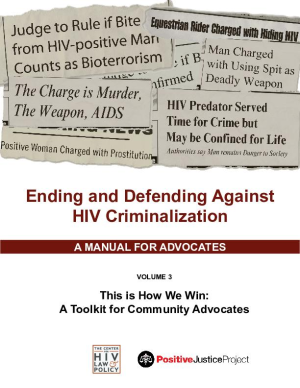
Ending and Defending Against HIV Criminalization: A manual for advocates. Vol 3: This is how we win. A Toolkit for community Advocates
Contains numerous criminalisation documents (also listed separately on this site), including Ten things anyone can do to help end HIV criminalization, How a Bill becomes a law, State-level legislative advocacy cheat sheet, How to talk about HIV criminalization with elected officials, media and others.
ВИЧ и законодательство: риски, права и здоровье
докладе, опубликованном в июле 2012 года, представлены данные и анализ сфер общественного здравоохранения, прав человека и законодательства, а также рекомендации законодателям и высокопоставленным политикам, гражданскому обществу, партнерам в целях развития и представителям частного сектора, принимающим участие в разработке мер для эффективной глобальной борьбы с ВИЧ.

Декларация Осло о криминализации ВИЧ-инфекции
Декларация отражает намерения и предложения представителей гражданского общества в отношении преодоления криминализации передачи ВИЧ как явления, которое нарушает права человека и выделяет людей, живущих с ВИЧ в особую дискриминируемую группу.