
The Expert Consensus Statement on the Science of HIV in the Context of Criminal Law – Five-year Impact Report: Bringing Science to Justice
In 2018, twenty leading HIV scientists published the ‘Expert Consensus Statement on the Science of HIV in the Context of Criminal Law’ (Expert Consensus Statement) to address the misuse of HIV science in punitive laws and prosecutions against people living with HIV for acts related to sexual activity, biting or spitting. The process involved undertaking detailed analysis of the best available scientific and medical research data on HIV transmission, treatment effectiveness and forensics. Building on an initial scoping report published in 2020, the HIV Justice Network (HJN) undertook further research between April and July 2023 examining the impact of the Expert Consensus Statement in cases and advocacy in the five years since its publication.

No HIV transmission from virally suppressed mothers during breastfeeding in rural Tanzania (2018)
Brief report from clinical practice in Tanzania which found no HIV transmission from mothers who were retained in care and had suppressed viral load whilst breastfeeding. They conclude: "Breastfeeding signifies a very low risk when mothers adhere to ART."
Women living with HIV in high-income settings and breastfeeding (2020)
A thorough review of policy guidance, science and practice in high income settings from Denmark. It concludes that "suppressive maternal ART significantly reduces, but does not eliminate, the risk of postnatal transmission of HIV through breastfeeding. However, it is important to recognize and acknowledge that some women living with HIV may wish to breastfeed their infant, in which both the healthcare providers and the women need evidence-based information about the risks and benefits to enable an informed decision."
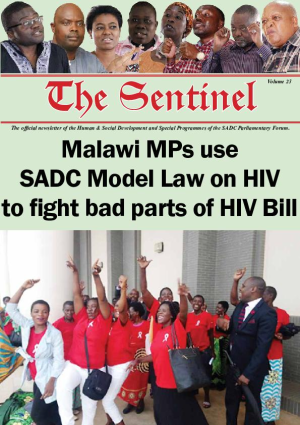
Malawi MPs use SADC Model Law on HIV to fight bad parts of HIV Bill
After nearly 10 years of intense debate and consultations, Malawi Members of Parliament voted to reject controversial provisions in their HIV (Prevention and Management) Bill. The Bill had included provisions that would have made HIV testing and treatment mandatory for specific people in a discriminating manner. Additionally, and perhaps more controversially, the Bill had sought, also, to allow criminalisation of HIV transmission, exposure and non-disclosure. This newsletter captures part of the debates leading to the passing of the final Bill.
Фактические данные по искоренению стигмы и дискриминации в связи с ВИЧ — Руководство для стран по реализации эффективных программ, направленных на искоренение стигмы и дискриминации в связи с ВИЧ в шести сферах
В этом отчете рассматриваются последние данные о том, что является эффективным в снижении стигмы и дискриминации в связи с ВИЧ в рамках ключевых программ по снижению уровня стигмы и дискриминации и расширению доступа к правосудию в шести основных сферах деятельности Глобального Партнерства.
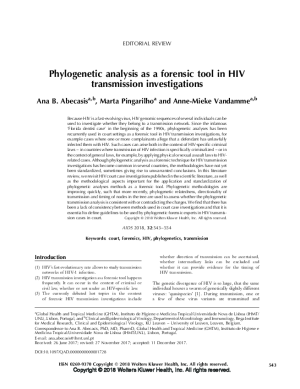
Phylogenetic analysis as a forensic tool in HIV transmission investigations
A review of HIV court case investigations published in the scientific literature, as well as the methodological aspects important for the application and standardisation of phylogenetic analyses methods as a forensic tool. Concludes that there has been a lack of consistency between methods and that it is essential to define guidelines to be used by phylogenetic forensic experts in HIV transmission cases.
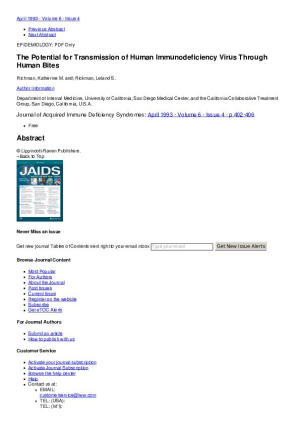
The potential for transmission of human immunodeficiency virus through human bites
Reviews evidence related to the potential for HIV transmission through human bites. Concludes that while biologically possible, transmission remains unlikely, risk is epidemiologically insignificant and as yet, has not been well documented.
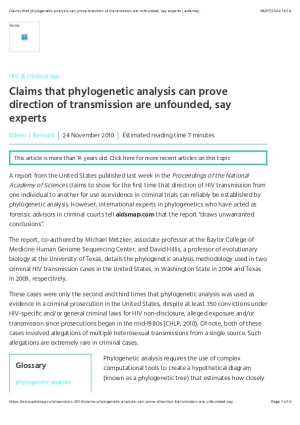
Claims that phylogenetic analysis can prove direction of transmission are unfounded, say experts
Questions the merits of a phylogentics article published in Proceedings of the National Academy of Sciences, and warns against relying on its conclusions.
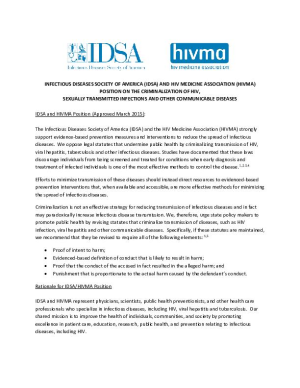
Position on the Criminalization of HIV, Sexually Transmitted Infections and Other Communicable Diseases
Highlights the detrimental effects of criminalization statutes and offers a statement of support for evidence-based prevention measures and interventions to reduce the spread of infectious diseases.
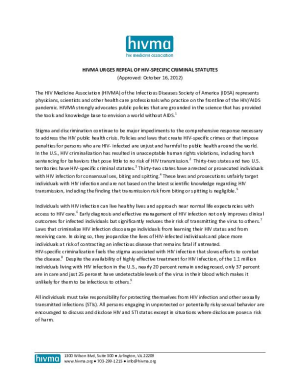
HIVMA Urges Repeal of HIV-Specific Criminal Statutes
Highlights the detrimental effects of HIV-specific criminalization and supprts modernization of laws and practices to reflect current science and knowledge about HIV, the promotion of education addressing stigma associated with HIV-specific criminalization, and a federal review of federal and state laws, policies and regulations.
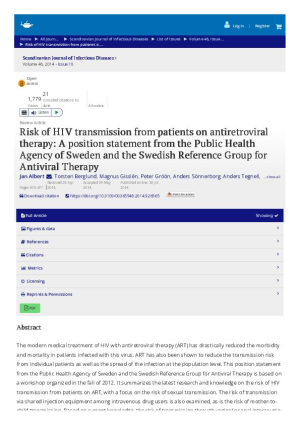
Risk of HIV transmission from patients on antiretroviral therapy: a position statement from the Public Health Agency of Sweden and the Swedish Reference Group for Antiviral Therapy
Summarises the latest research on the risk of HIV transmission from people on suppressive treatment, focusing on risk of sexual transmission. Authored by the Public Health Agency of Sweden and the Swedish Reference Group for Antiviral Therapy.
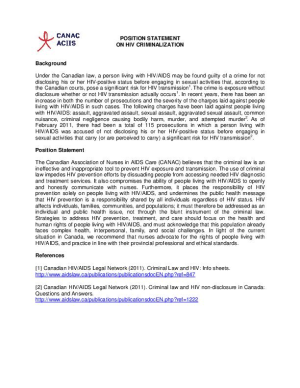
Position Statement on HIV Criminalization
States that criminal law is an ineffective and inappropriate tool to prevent HIV exposure and transmission because it dissuades people from accessing diagnostic and treatment services and compromises open and honest communication with nurses. Recommends that nurses advocate for the rights of people living with HIV/AIDS.