
Criminalisation of HIV transmission: implications for public health in Scotland
Article analysing of the first case of HIV transmission in the UK. The authors conclude that far from protecting the public, the judgment has endorsed abrogation of individual responsibility in sexual partnerships by asserting a legal duty of disclosure on the infected partner. It is likely to undermine uptake of HIV testing and risks a one third increase in new HIV infections in Scotland. It also underlines the need for research scientists to anticipate that potentially incriminating results, even in unlabelled studies, may be followed up by forensic requests from individual study participants or by police warrant and recommends an urgent review by the Scottish Executive to minimise the negative effects on public health and molecular science.
Expert meeting on the scientific, medical, legal and human rights aspects of criminalisation of HIV non-disclosure, exposure and transmission
This report contains the views, opinions and suggestions for policy orientation and formulation of the participants at an expert meeting (convened on 31 August–2 September 2011 in Geneva, Switzerland) that brought together scientists, medical practitioners and legal experts in order (i) to consider the latest scientific and medical facts about HIV that should be taken into account in the context of criminalisation, and (ii) to explore how to best address issues of harm, risk, intent and proof—including alternative responses to criminalisation—in light of this science and medicine.
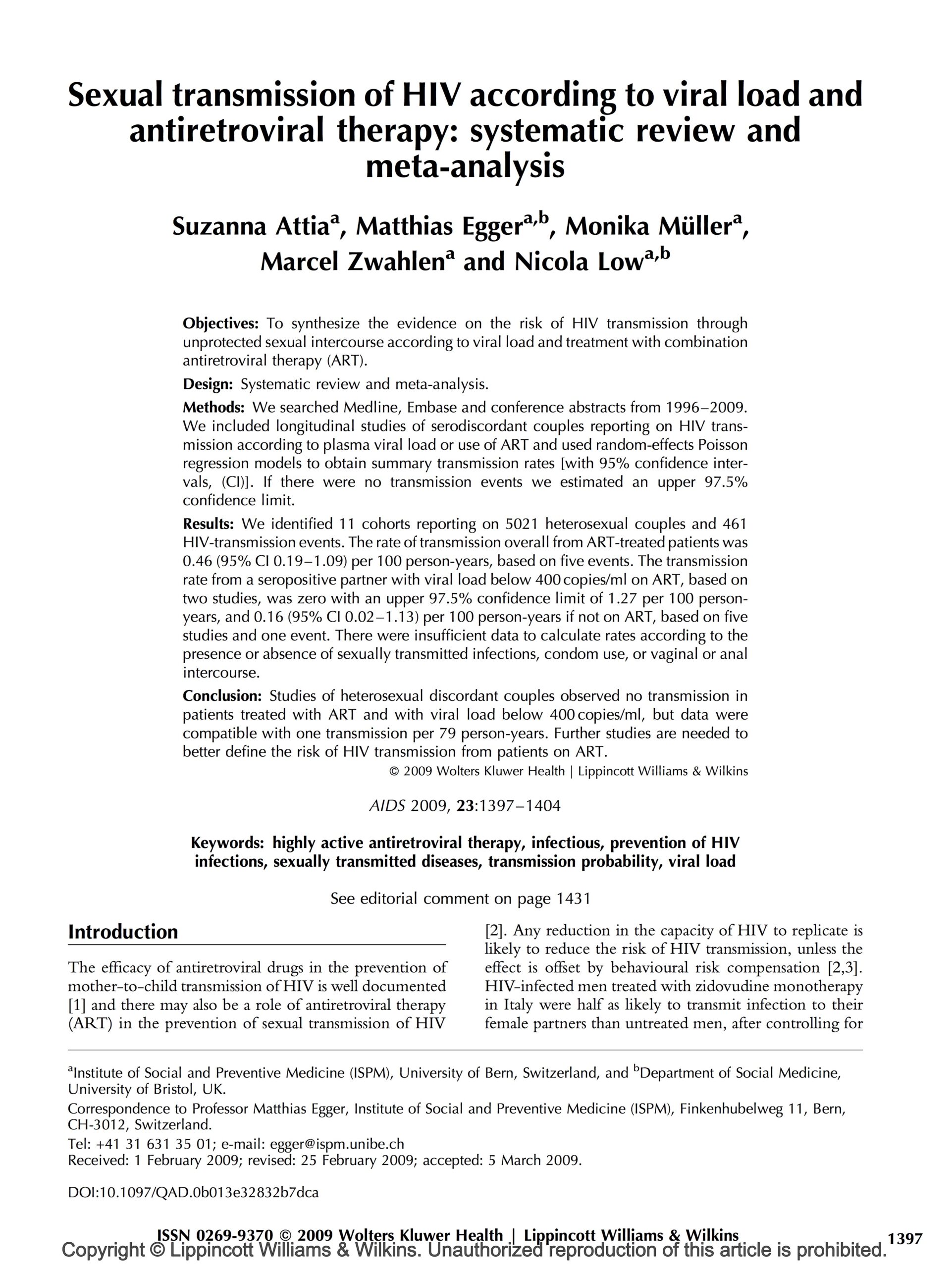
Sexual transmission of HIV according to viral load and antiretroviral therapy: systematic review and meta-analysis
Review and meta-analysis of 11 articles found no HIV transmission among heterosexual discordant couples when the positive patient was treated with ART and had a viral load below 400 copies (with data compatible with one transmission per 79 years).
The effect of sexually transmitted co-infections on HIV viral load amongst individuals on antiretroviral therapy: a systematic review and meta-analysis
Analyses 14 studies to find evidence about the effects of STI co-infection on transmission from individuals on ART is very limited. Available data suggests the average effect of STI co-infection on HIV viral load in individuals on ART is unlikely to decrease the effectiveness of treatment as prevention. However, limited data precluded ruling out the possibility that particular STIs pose a larger threat.
The problem of ‘significant risk’: Exploring the public health impact of criminalizing HIV non-disclosure
Emphasizes that the concept of significant risk undermines communication about transmission risk during HIV counselling and contributes to contradictory advice about disclosure obligations. Criminalization discourages openness about HIV non-disclosure in counselling relationships. The recontextualization of public health interpretations of significant risk in criminal proceedings can intensify criminalization.